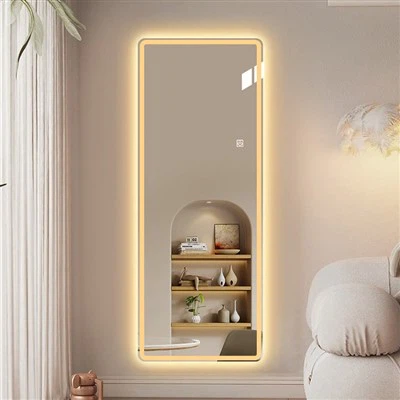
From childhood to adulthood, you must have had an experience that every time you come out of the shower, you can see that the bathroom mirror is foggy. The situation is more serious in winter. Every time you have to wipe off the water vapor on the mirror to see yourself in the mirror clearly, which is very inconvenient. So why does the mirror fog up? Is there any way to clear it?
This article introduces the origin, working principle, control components, installation and other aspects of the defogger mirror, which can give you a general understanding of the defogger mirror.

Why Does The Mirror Fog Up?
The reason why the mirror fogs up is very simple. Usually when we take a shower, the hot air will drift outward, and the mirror itself has a low temperature. When the high temperature meets the low temperature, the heat energy released by the cold will condense into small water droplets. It is like a myopic person entering a warm place from outside in winter, and fog will appear on the glasses, or the indoor glass in winter is also foggy. This is the same principle.
Is There Any Way to Clear the Fog?
There are two types of mirror surfaces. One is the ordinary mirror surface, which is the most common and has no anti-fog effect; the other is the anti-fog mirror surface, which is what we call the anti-fog mirror. It has a built-in heating element to prevent condensation and fogging. This mirror is particularly useful in humid environments such as bathrooms.
Growing Use of Anti-fog Mirrors
Although ordinary mirrors can be wiped clean when they are fogged, the fog will quickly cover the mirror again. In many places such as commercial hotels, spas, or bathrooms in our homes, quick and convenient is our demand. Clear vision is very important. At this time, fog-free mirrors can provide a more comfortable experience. According to multiple market research reports published in 2021, the global anti-fog mirror market is expected to grow at a compound annual growth rate (CAGR) of more than 6% from 2021 to 2028. Influencing factors include: increased disposable income in emerging countries, resulting in increased demand and capital investment for new decoration and bathroom facilities. It is expected that by 2028, the anti-fog mirror market will account for 58% of household applications, 42% of commercial applications, and revenue of US$788 million.
The Origin of Anti-fog Mirrors
Because the use of hot water showers in the bathroom in the early days would generate a lot of steam, making the mirror surface blurry, people still wiped the mirror manually at this time, but this would leave fingerprints and water marks on the mirror surface. Some temporary solutions, such as heating the mirror surface with a front-end machine, are not long-term solutions.
As people's needs continue to increase and electric heating technology continues to develop, people have begun to try to use heating elements to control the temperature of the mirror surface, so that the temperature of the mirror surface and the surrounding air remains at a relatively consistent level to prevent water droplets from condensing. At this time, an electric heating pad or electric heating film is usually installed on the back of the high-end mirror. In the mid-to-late 20th century, many engineers and designers realized that if a heating element was installed on the back of the mirror, the condensation of water droplets would be better controlled. At this time, the defogger mirror was invented. These components heated the mirror surface through electric current, effectively preventing the formation of fog. At that time, the defogger mirror was also called a heating mirror.
Application Scope
In the early days, the defogger mirror was only popular in high-end residences and hotels. Later, with the continuous development of technology, the cost was gradually reduced, and it was later applied to ordinary homes and commercial places.
Now the technology of the defogger mirror is relatively mature. It not only has the defogger function, but also has other functions, such as touch control, LED lighting, Bluetooth connection, etc., which improves the user experience.
Basic Working Principle of the Defogger Mirror
Heating element: The core component of the defogger mirror is the heating element behind it. These heating elements can be electric heating films, electric heating pads or heating coils.
When the steam comes, the heating element will play its role, heating the mirror surface by generating heat and making the mirror surface temperature slightly higher than the temperature of the bathroom, so as to prevent the water vapor from condensing into fog on the mirror surface.
Temperature control: Ordinary defog mirrors require us to manually turn on its defog mode. Some high-end defog mirrors are also equipped with intelligent temperature control systems, which can freely adjust the heating temperature according to the ambient temperature, so as to achieve the best defog effect and energy saving effect.
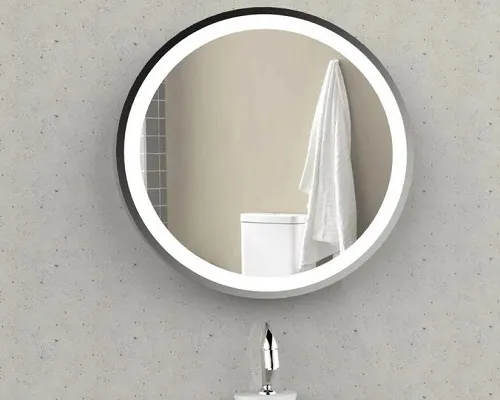
Detailed Components
Electric heating film: The electric heating film is a thin film heater. In order to achieve the conductive effect, it is usually made of conductive materials, such as carbon fiber or metal alloy. The electric heating film is pasted on the back of the mirror. When the current passes through, the electric heating film will evenly heat the entire mirror surface. Generally, the electric heating film has the characteristics of high efficiency and uniform heating, so it is more suitable for large-area mirrors.
Electric heating pad: The electric heating pad is similar to the electric heating film, but unlike the electric heating film, the electric heating pad is relatively thicker and consists of multiple layers of materials, including an insulating layer, a protective layer, and a thermal conductive layer. The electric heating pad is usually used in applications that require stronger heating power. When the electric heating pad is installed on the back of the mirror, it can quickly heat up the mirror temperature by heating with electric current.
Heating coil: The heating coil is a spiral heating element, usually made of nickel-chromium alloy or similar materials. The spiral structure can provide efficient heating, but the heat distribution may not be as uniform as the electric heating film or electric heating pad. Therefore, the heating coil is more suitable for defogging needs in small areas or specific areas.
Control System
1. Switch control: Defog mirrors are basically equipped with an independent switch. We can turn it on manually before bathing, so that the defog function starts working. After bathing, when the temperature in the bathroom gradually decreases, we can manually turn off the defog function. This switch can be a normal mechanical switch or a touch switch, which is more convenient.
2. Timing control: Some specific defog mirrors also have a timing switch function. You can freely adjust the working time of the heating element, and you don't have to worry about forgetting to turn off the defog function after taking a bath, which will cause the mirror to overheat. It can save energy and adjust time, which greatly improves the user experience.
3. Intelligent control: The higher-end defog mirror is also equipped with an intelligent control system. When it is working, it can freely adjust the power of the heating element according to the ambient temperature. There is no need to worry about whether the heating is too high or too low. It can achieve the best defog effect and save energy.
Safety and Energy Saving
Insulation and waterproof design: The core component of the defogger mirror, the heating element, must be insulated and waterproof, because most of them are used in humid environments. In order to ensure people's safety, the heating element is usually wrapped in waterproof materials, which can control the circuit and have a waterproof effect.
Low power consumption function: The heating element consumes a lot of energy when working. Modern defogger mirrors also focus on reducing energy efficiency. The use of low-power heating elements can reduce energy consumption, including some mirrors that can be timed and automatically control the temperature, which can further reduce unnecessary energy use.

Application and Installation
Installation location: The defogger mirror is usually installed on the wall of the bathroom, which is convenient for connecting the power supply to achieve the defog effect for the mirror. When installing, pay attention to the reliability and safety of the heating element and the power supply connection.
Power supply requirements: Because the defogger mirror is generally installed on the wall of the bathroom, the power socket in the bathroom should be waterproof at all times, and the hands should also be kept dry when touching the power supply.
Does the Mirror Have to be Defogged?
Although glass is durable, everything has its lifespan. For mirrors, water vapor and moisture are its killers. If the mirror surface is not cleaned and wiped regularly, it will begin to oxidize and fog over time. Once the mirror surface begins to be damaged and corroded, it is difficult to restore it to its original state, so we must clean the mirror surface in time and keep it clean.
Methods for Cleaning Defog Mirrors
We prepare soft cloth (such as microfiber cloth), warm water, mild soap or glass cleaner, and cotton swabs (for cleaning corners and hard-to-wipe places). After these items are prepared, you can moisten the soft cloth with warm water, but there should not be excessive water. After wringing the soft cloth, keep it slightly wet, so that you can ensure that there will be no large amount of water marks when wiping. If there are more stubborn fingerprints and stains, we drop a few drops of mild soap or glass cleaner on the soft cloth, and avoid using strong acid and alkali cleaners to avoid damaging the mirror surface or heating the original. Then we gently wipe the mirror surface. Note that it is best to wipe in one direction, from top to bottom or from left to right, to avoid leaving scratches. Dip a cotton swab in a small amount of detergent and clean the corners to make sure all fingerprints are removed. Finally, we wipe it again with a clean soft cloth, so that the mirror is clean.