Maybe in the locker room at the mall, you picked out a nice dress and looked good in the mirror. But when you go home, you don't look that good in the mirror. Why does one mirror look good and the other look different? Don't worry if your vision is faulty. Any number of factors, including lighting and mirror Angle, can affect how you look in the mirror. In this article, we'll tell you in detail why you look different in different mirrors. And it will also tell you why we look different in the mirror and in the photo. And which mirror or photo will make you look more accurate.

Things you should know
1. The light, Angle, and thickness of the glass can all cause you to look different in different mirrors.
2. A mirror is not the same as a photo; it inverts your image and makes you look different in the mirror than in the photo.
3. We usually look in the mirror and feel more realistic than photos. That's why it sometimes feels better to look in the mirror than to take a picture.
Why you look different in different mirrors
There are many reasons why different mirrors look different, and here are a few reasons.
lamplight
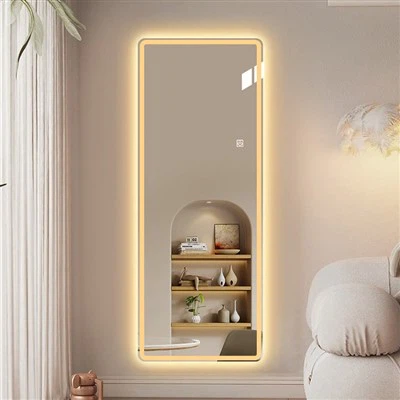
If you look closely at the mirror in a mall changing room. Then you may find that the mirror in the fitting room looks better than the mirror in your home. Because it usually has lights around the mirror, it will look more intuitive. The colors of the clothes are usually bright.
And the mirrors in gyms often have soft lighting on them. This soft light creates a subtle shadow area on your body. More highlights your muscle line, look excellent fitness results. And compared to direct light, soft light can blur out imperfections on the figure. It looks more attractive in the overall line.
Concavo-convex surface
The mirror in our lives is basically a flat mirror. Under ideal conditions, all flat mirrors lie flat and reflect the original image. In this case, we see ourselves as we are. However, most mirrors have certain curves and bends. This phenomenon distorts your image and slightly enlarges or diminishes it in certain parts of your body.
In some amusement parks, science and technology museums, there are some mirrors on the concave and convex surface. Most of these mirrors are for play. They can make your face look smaller, fatter, or more crowded. Convex mirrors also make you look shorter, and concave mirrors make your reflection look taller.
Generally, the outside mirror, even the concave-convex mirror, will not be more obvious than the play place. So if you want to tell if the outside mirror is deformed, there is an easy way. You just need to see if the lines in the reflection that should be straight are bending. Something like a door frame. Some may not be obvious and need to be watched carefully.
Thickness
Different mirror thicknesses can also affect your image. If your proportions look out of sync in one mirror but not in the other, the glass may be too thin. The glass itself is very heavy, so if it is too thin, it cannot bear its own weight. This will cause bending deformation, so your proportions will look out of alignment.

If you are looking for a mirror for your home or business use. It is recommended that you purchase a mirror that is at least 3/8 inch (1 cm) thick. This thickness ensures that individual proportions are not affected.
You can also add a strong wooden backing board behind the mirror. In this way, even if the glass is very thin, it can prevent bending and deformation. But I still recommend directly choosing the correct thickness of the mirror, which also saves time and effort.
Materials
Mirrors are actually made of more than just glass. Some mirrors are made of plastic acrylic resin. These mirrors are usually of poor quality because they are prone to bending. And they don't look as clear as glass. It is light in weight, slightly less reflective, and also prone to scratches. This is not suitable for body photography, most of them are still used for decoration or temporary use.
There is also a stainless steel mirror, which is durable and corrosion resistant. But it also doesn't reflect as well as glass mirrors. In addition, there are aluminum mirrors, polycarbonate mirrors, silver mirrors and so on. Mirrors of these materials have their own advantages, but they are not as good as glass mirrors.
So don't worry if you look better in the mirror at home than in other places. It's not about you, it's about what the mirror is made of. In general, you can also distinguish between glass mirrors and acrylic mirrors in life. The reflection effect of the glass mirror will be stronger, so the image is clearer and more accurate. Acrylic mirrors are much lighter than glass mirrors and have some flexibility.
Angle
Places like clothing stores and gyms are all trying to make you look good. They usually tilt the back of the mirror down, and the surface of the mirror will face up slightly. This Angle will make your body look better. In particular, your legs may look longer and your body may look thinner. Together with the lighting, the whole person will look pleasing to the eye. Therefore, the most accurate reflection is the mirror hanging flat on the wall.
Why do people look different in the mirror than in photos
It's a common phenomenon that people look different in mirrors and photos. There are many reasons behind it. Some of the main factors are described below.
Mirror inversion: The image in the mirror is reversed left and right. It shows a mirror image of you, not what you really look like. People look in the mirror more often, so we are actually more used to seeing ourselves in the mirror. And the photos, though, reflect us as we really are. But because you don't take pictures so often, it feels a little unnatural.
Camera lens distortion: Different lens types can also affect the effect of the shot. For example, a wide-angle lens may magnify features in the middle of your face, which can make your nose appear larger. Shooting distance and focal length also affect the degree of image distortion. Close-up shots can create a "fisheye effect," which can make the face appear less natural.
Light and shadow: The light reflected by a mirror is determined by the ambient light you face in the mirror. The light in the photo is basically determined by the light source of the shot. It's natural for us to look at ourselves in the mirror under natural light. But if you are shooting, you generally need to fill the light to shoot better. Different light source effects will also have different effects on skin texture. So the image is different from the mirror.

Posture and expression: We tend to be casual and relaxed when looking in the mirror. Sometimes I can pose with confidence. So it's easy to find the best Angle. But if you are filming, you may feel nervous in front of the camera. When people are nervous, they are likely to have unnatural expressions and not dare to pose with exaggerated gestures. So at the moment of taking a picture, you may still be adjusting expressions, movements, etc. In this way, the effect may not be as good as when you look in the mirror.
Psychological and emotional factors: Our self-image perception is generally generated through the mirror. So we have a certain psychological expectation of our own image, and we also form a habit. When the photos do not meet our expectations, it is easy to have a psychological gap. This is why people always think that the picture is not good. Sometimes, photos are also stories, and seeing them may remind you of something. So there's some emotional response. This emotional response also affects the subjective perception of the image in the photo.
Technical factors: The camera technology of shooting people is also a big part of the quality of photos. Skilled photographers also make good pictures. Of course, the quality of the camera equipment is also good. In the later stage, the photo image can be adjusted again after retouching and filtering. The altered photo will look better than the original, but it won't necessarily look exactly like you in the mirror.
Background and environment: The background in a photograph is usually different from that in a mirror. Various colors converge, and the brightness will affect the overall effect. Including shooting Angle, sufficient ambient light or not will have an impact on the image.
Sum up
To sum up, we may see different things in different mirrors. This depends on the lighting of the mirror, whether it is convex or not, the thickness, the material and the Angle. The reason why we look different in the mirror and in the photo is generally both equipment and human factors. Understanding these reasons also helps us to accept different aspects of ourselves in many ways.