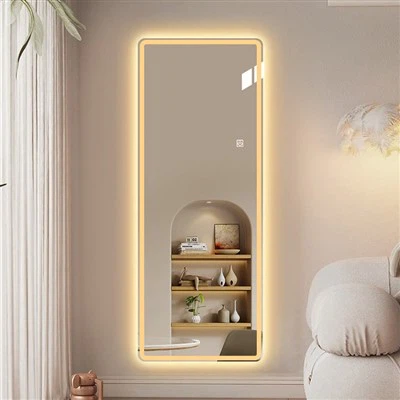
Wall mirrors are very common in life. They can not only help us check the effect of clothing, personal appearance, but also improve the light, visual effects and overall beauty of the interior space. There are many types of wall mirrors, each with its own unique advantages. It can be adapted to different places and various styles. The following describes the various types of wall mirrors. Help you better understand its characteristics and uses.

Full-length mirror
The most common thing we use in our lives is the full-length mirror. Full-length mirrors are generally larger in size and reflect the entire body. Usually used in cloakrooms, bedrooms, stairwells and other locations. The full-length mirror not only allows us to tidy up our appearance, but also plays a decorative role. It's a daily necessity in our lives.
Decorative mirror
Decorative mirrors are mainly used for decoration. Because its design is more unique, there are often exquisite decorative details on the border and mirror. By decorating the entire mirror, it can be adapted to different styles. Including modern style, retro style and so on. Usually can be used in the living room, dining room, porch area, these places can increase the visual highlight and the sense of space art.
LED mirror
LED mirror is a modern mirror product that combines LED lighting technology and traditional mirrors. It not only provides the reflection function of ordinary mirrors, but also integrates the LED light source. To provide users with more uniform, soft lighting. Most commonly used in cosmetic mirrors. Even if the room is dark, this mirror can also play a good role in lighting. In addition, LED mirrors are also widely used in family bathrooms, hotels, commercial Spaces and so on. It is popular because of its beautiful and practical characteristics.
Round mirror
Round mirrors have soft edges. Compared with the square lines in the room, it can neutralize the rigidity of the room. Provide mild visual effects to make people feel more comfortable. They can be a highlight in an interior decoration. Add a sense of coordination by breaking the sense of straight lines in space. Generally used in bedrooms, living rooms and bathrooms, making the overall effect more warm.

Elliptic mirror
The elliptical mirror itself is the evolution of the circular mirror, that is, the shape has changed from circular to oval, the design is elegant, the curve is smooth, and the shape makes the space look softer and rich in layers. Its advantages are similar to circular mirrors, which can soften the space lines and increase the space level.
Antique mirror
Genuine antique mirrors have a long history and high ornamental value. Because of its unique craft and rare shape, it is favored by collectors. Antique mirrors were first produced in Murano and silver-plated in Venice in the 16th century. It was not until the 17th century that antique mirrors began to be made in England. Later, at the end of the 18th century, the technology was upgraded and better and larger mirrors entered the market. Antique mirrors are decades or even centuries old and reflect the culture, artistic style and level of craftsmanship of a particular period.
Glass brick mirror
Glass brick mirror has a very unique visual effect, is a decorative material that combines the mirror effect and glass brick. It has both the firmness and light transmission of glass bricks, and the reflection function of mirrors. During the manufacturing process, one or more sides of the glass brick are mirrored. Usually silver or aluminum is used as the reflector. The reflective material is uniformly coated on the surface of glass brick by chemical coating or physical evaporation. The result is a mirror-like effect with high reflectivity.