Short answer: textured glass is see-through for light but not for detail. A textured panel lets brightness and color pass through while blurring the shapes behind it, so you see that the other side is lit, not what is on it. It sits between fully clear window glass and a solid wall, which is exactly why architects, contractors and distributors specify it where privacy and daylight both matter.
At Luck Glass, textured glass is part of our decorative and obscure-glass range, produced on multiple deep-processing lines and exported to many countries worldwide. This guide explains what the material is, how much you can actually see through it, how it differs from frosted glass, where it is used, and what to confirm before you order.
What Is Textured Glass?
Textured glass is flat glass that carries a raised or rolled pattern across its surface. The pattern is  created while the glass is still molten, by passing it between two textured rollers that emboss a repeating design-reeds, ripples, grids, diamonds or fine satin fields-directly into the sheet as it forms. Because the texture is integral to the panel, it cannot scratch off, peel or fade the way an applied film can.
The result is a semi-transparent sheet: light and color come through, but the view is broken into a soft, unreadable glow. In the trade this sits inside the broader obscure-glass family, which also covers acid-etched, sandblasted and frosted finishes. The practical difference is that a patterned surface gives you design character-a visible texture-rather than a flat uniform blur.
For specifiers, the key point is permanence. The pattern survives cutting, edgework and even the tempering furnace, so it performs for the full life of the installation.
See how the base material is produced ⇒ Related Post: "How Is Glass Made?"
Is Textured Glass See Through?
The honest answer is "partly." Textured glass is see-through for light but not see-through for detail. Stand in front of a panel and you will see that the room on the other side is lit, and you may make out broad shapes, colors and movement. What you will not see is a clear image-no faces, no readable text, no sharp edges.
How much you can see depends on three things: the depth of the pattern, the distance from the glass, and the lighting contrast behind it. A deep, bold pattern such as a heavy reeded or grid design hides far more than a fine satin texture. The closer you stand and the brighter the light behind the panel, the more detail becomes visible.
This is why textured glass is described as translucent rather than transparent. Transparent glass (ordinary clear float) lets you see through it clearly. Translucent textured glass lets light through while obscuring the view-the effect most buyers want for bathrooms, doors and partitions.
If your project needs complete privacy, pair textured glass with a tint or specify a denser pattern. If you only need to soften a view while keeping it bright, a light texture is enough.
Compare with the frosted alternatives ⇒ Related Post: "What Are The Five Types Of Frosted Glass?"
Discuss your project requirements with our team
Textured Glass vs Frosted and Obscure Patterned Glass
People often use "textured," "frosted" and "obscure" interchangeably, but they describe different things. Frosted glass usually means a smooth, even satin surface made by acid-etching or sandblasting-uniform, with no repeating design. Decorative textured glass carries a visible, repeating pattern. Obscure patterned glass is the wider category that includes both: any glass whose surface is shaped or treated to reduce visibility.
For a buyer, the choice comes down to look and function. Frosted satin reads as calm and minimal; decorative textured glass reads as intentional and designed, adding material character to the space. Both obscure the view and both transmit light, so either can serve a bathroom or office partition.
When you compare options, judge them under the actual lighting of the install location, not a showroom. A pattern that looks private under bright sales lights may reveal more next to a sunlit window. Obscure patterned glass in a deeper relief will always outperform a fine etch for privacy, at the cost of a more pronounced visual texture.
Explore the full pattern range ⇒ Related Post: "What Are Some Different Types Of Glass Patterns? A Guide to Textures, Privacy And Various Glass Patterns"
Where Textured Glass Is Used
Because it diffuses light without blocking it, textured glass fits almost any place that needs separation without darkness.
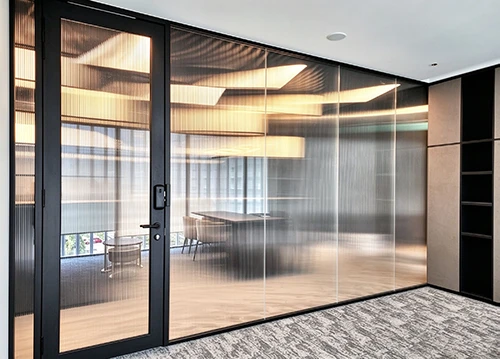
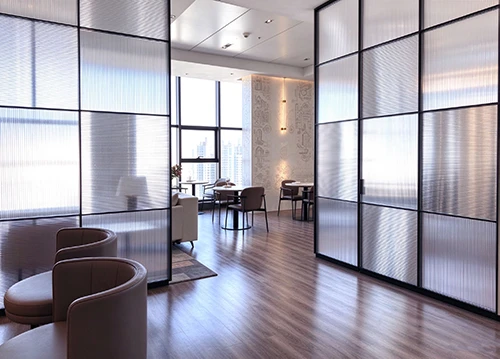
Textured glass panels are the workhorse form: large sheets cut and processed to size for walls, screens and infill panels. In offices they form meeting-room partitions that keep a floor plate feeling open while stopping passers-by from reading a whiteboard. In homes they turn a solid hallway into a light-filled space.
Textured glass panels for doors are one of the most common specifications. A textured insert in a bedroom, bathroom or entry door lets daylight travel between rooms while keeping the interior hidden-solving the "solid door feels closed off" problem without going fully clear. For shower enclosures the textured face also hides water spots better than clear glass, cutting cleaning frequency.
Cabinet fronts, balcony rails and kitchen splashbacks are smaller but growing uses, where the pattern adds texture without clutter. In all of these, the glass can be supplied clear or tinted, tempered for safety, and cut to the exact panel size the project needs.
Three further applications are worth naming, because they use the material in ways that surprise first-time buyers. In retail and hospitality, textured glass works as a shelf display backing and a counter screen: the goods stay lit and visible, while reflections and clutter are suppressed. In healthcare and education, it is used for consultation-room screens and classroom partition panels, where a privacy line is needed without building a wall. And in residential balcony and stair work, it replaces solid balustrade infill, because a patterned panel lets light through to the neighbouring unit while still satisfying the safety requirement of a barrier.
See where else obscure glass fits ⇒ Related Post: "What Is Frosted Glass Used For? "
Product Features That Decide Your Specification
Textured glass is not a single product but a family of surfaces, and the right panel depends on which  characteristic drives your project. Five features decide most specifications.
Light transmission versus privacy. Every pattern sits on a spectrum. A fine satin field passes a high proportion of light while blurring detail; a deep reeded, grid or diamond relief hides considerably more and still admits daylight. If you need brightness without visibility, a mid-density pattern is usually enough. If you need genuine separation in a bathroom, a deeper texture or a tint is the safer route.
Permanence of the surface. Because the texture is formed during manufacturing, it cannot peel, yellow or wear out the way an applied film does. This matters most in high-traffic and high-moisture locations-shower screens, entry doors, kitchen splashbacks-where an applied film would be the weak point in the assembly.
Panel-to-panel consistency. On a large wall or a run of matching doors, batch consistency is what separates a professional installation from an obvious patchwork. Ask how panels are matched within a run and how much visible variation the pattern tolerates.
Thickness and edgework. Door and shower inserts are typically specified in 8mm–12mm tempered glass; larger wall panels may need 12mm or heavier depending on the support conditions and the applicable loading code. All sizing and hole work must be completed before tempering, because a tempered panel cannot be cut, drilled or re-edged afterwards. Edges are polished rather than chipped, so the panel reads as finished on both faces.
Color and customization. Pattern, tint, panel size, hole positions and edgework are all set to your drawing. Standard tints cover clear, ultra clear, blue, green, grey and bronze, with custom colors available for projects that need to match a specific palette-amber textured glass, for example, is specified where warm tones need to coordinate with joinery or a lighting scheme. Ultra clear is the usual choice where maximum light transmission and a neutral appearance matter.
Plan your thickness specs ⇒ Related Post: "What Thicknesses of Glass Are Available? A Quick Guide"
Why Work With A Glass Supply Company
Choosing the right glass supply company affects more than price: it determines whether your panels arrive consistent, certified and on schedule. For project-based B2B orders-distributors, contractors, importers-the supplier should handle cutting, edging, drilling, tempering and the textured finish in-house so tolerances stay controlled.
A capable supplier will send physical samples so you can judge the pattern and privacy level in your own lighting, provide test reports (ANSI Z97.1 for the US market, EN 12150 for Europe), and explain the tradeoffs rather than just quoting. Consistency across multi-sheet walls matters: ask whether all panels come from one production run, because a visible difference in texture density between adjacent sheets shows under natural light.
Luck Glass runs multiple glass and mirror deep-processing lines in China and exports to many countries across North America, Europe, the Middle East, Oceania and beyond. For buyers needing more than stock items, custom textured glass is produced to drawing-pattern, size, tint and edgework matched to the project.
Choose a reliable manufacturing partner ⇒ Related Post: "China's Leading Glass Manufacturers Updated 2026: Trends, Quality, And Global"
Tempering and Safety
Most textured glass for doors, showers and partitions is specified as tempered safety glass. Tempering does not remove the pattern; the texture survives the furnace unchanged, so you keep both the design and the safety rating.
The constraint is sequencing: all cutting, drilling and edge polishing must be completed before the panel is tempered. Once tempered, the glass cannot be reworked, so dimensions and holes have to be confirmed at order time. For the US market check ANSI Z97.1; for Europe, EN 12150 is the reference.
Laminated textured glass is the alternative where impact resistance or post-break retention is required-two layers bonded with an interlayer. The right call depends on the location and the applicable glazing code.
Compare the two safety routes ⇒ Related Post: "Which Is Better, Tempered Glass Or Laminated Glass?"
Frequently Asked Questions
Q: Is textured glass see through?
A: Partly. It is translucent-light passes through but shapes and faces stay blurred. You see that the other side is lit, not what is on it.
Q: What thickness should I use for a door?
A: Door and shower inserts are typically 8mm–12mm tempered. Larger wall panels may need 12mm or more depending on support and code.
Q: How do I choose the right pattern for privacy?
A: Judge under the actual install lighting, not a showroom. Deeper patterns and tints hide more. Request a sample and hold it where the glass will be installed.