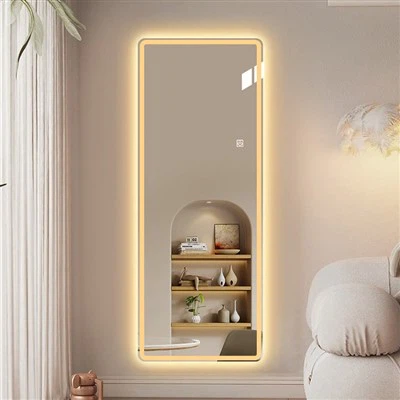
In the fast-evolving world of interior design, hospitality procurement, and home renovation, LED smart mirrors have transitioned from luxury hotel amenities to essential modern fixtures. Driven by the "luminous revolution," B2B buyers-including distributors, real estate developers, and bathroom vanity manufacturers-are ordering these products in unprecedented volumes.
However, beneath the sleek glass surface and the radiant glow of the integrated LEDs lies a critical vulnerability that separates a short-lived commodity from a premium, long-lasting investment. That vulnerability is mirror oxidation, commonly known in the industry as "black edges" (or desilvering).
For B2B buyers, a premium appearance at delivery is not enough. If an LED mirror begins to develop unsightly dark spots or corroded margins within six to twelve months of installation, your brand reputation suffers, warranty claims skyrocket, and project costs inflate.
This comprehensive technical guide will demystify the science behind mirror backing, explain why LED mirrors are uniquely susceptible to corrosion, and provide actionable criteria to identify high-quality backing processes that guarantee long-term durability.
1. The Anatomy of a Mirror: Understanding the Layers
To understand why mirrors degrade, we must first understand how they are constructed. A standard modern mirror is not just a piece of glass; it is a multi-layered composite structured as follows from front to back:
Float Glass Substrate: The top transparent layer, ideally made of ultra-clear, low-iron glass for perfect color rendering.
Reflective Metallic Layer: Traditionally made of silver ($Ag$) or aluminum ($Al$). This layer turns the transparent glass into a reflective surface by bouncing back light waves.
Sensitizing/Adhesion Layer: Often a microscopic film of tin ($Sn$) or palladium ($Pd$) used to bond the silver chemically to the glass.
Protective Backing Paint: One or two layers of specialized industrial paint designed to seal the metallic reflective layer from air, moisture, and chemical pollutants.
When environmental factors penetrate the protective paint, the metallic silver layer undergoes a chemical reaction-oxidation-turning the silver into silver sulfide or silver oxide. Visually, this manifests as dark streaks, creeping shadows, or a "cloudy" aesthetic along the perimeter.
2. Why LED Smart Mirrors are at Higher Risk for "Black Edges"
Standard decorative mirrors hanging in a dry living room rarely suffer from rapid desilvering. However, LED smart mirrors operate under a perfect storm of destructive environmental variables:
A. The Humid Bathroom Microclimate
LED mirrors are predominantly installed in bathrooms. Shovels of hot steam, humidity cycles, and condensation create a highly corrosive environment. Water droplets pool at the bottom edge of the mirror frame via capillary action, constantly testing the integrity of the backing paint.
B. Thermal Stress from Electronic Components
Smart mirrors house integrated electronics: LED drivers, touch sensors, copper wiring, and anti-fog heating pads (demisters). These components generate localized, fluctuating heat. This constant thermal expansion and contraction can cause micro-fissures in low-quality backing paints, allowing moisture to seep directly into the reflective silver layer.
C. The Dangers of Edge-Cutting and Processing
LED mirrors often require complex processing-such as CNC custom shaping (arched, irregular, half-moon), beveling, or frosting sections of the glass to allow LED light to shine through. The mechanical friction and heat generated during cutting and sandblasting stress the edge seals. If the manufacturer does not re-passivate or properly seal these raw edges post-processing, oxidation will begin at the boundaries almost immediately.
3. Copper-Free vs. Traditional Copper Mirrors: The Golden Standard
When evaluating suppliers, the most critical specification you must inspect is the chemical composition of the mirror chemistry.
| Feature | Traditional Silver Mirror | Eco-Friendly Copper-Free Mirror |
| Reflective Layer Protection | Uses a thin copper film to stabilize the silver layer before painting. | Replaces copper with an advanced chemical passivation treatment. |
| Oxidation Resistance | Moderate. Highly susceptible to humidity and atmospheric pollutants. | Ultra-high. Up to 3 times more resistant to atmospheric corrosion. |
| Environmental Impact | High. Lead and copper waste during production pollute water grids. | Low. Zero copper waste, aligned with global RoHS/LEED standards. |
| Black Edge Risk | High in wet/humid environments within 1–2 years. | Negligible. Maintains structural edge integrity for over 5–10 years. |
Traditional mirrors rely on a layer of copper to bind the silver and backing paint. However, when moisture hits copper, it accelerates galvanic corrosion, destroying the silver backing. Premium manufacturers like Luck Glass utilize 100% Copper-Free and Lead-Free mirror technologies. By substituting copper with a proprietary, eco-friendly passivation agent, the chemical bond is strengthened, and the mirror's resistance to clouding and edge corrosion increases exponentially.
4. B2B Inspection Checklist: How to Verify High-Quality Backing and Edge Processes
As a global buyer sourcing containers of LED mirrors, you cannot rely solely on the catalog description. You need concrete methods to verify quality during factory audits or pre-shipment inspections.
1. Request CASS and Salt Spray Test Reports
Do not guess the lifespan of a mirror-look at the laboratory data. Ask your manufacturer for certified testing documentation:
CASS Test (Copper-Accelerated Acetic Acid Salt Spray Test): This is the industry-standard accelerated aging test for mirrors. A high-quality copper-free mirror must withstand at least 120 hours (ideally 240+ hours) in a CASS chamber without showing edge corrosion exceeding 0.2mm.
Neutral Salt Spray (NSS) Test: Premium backing paints should easily clear 480 hours of continuous exposure without peeling or blistering.
2. Verify the Paint Layer Thickness and Type
Low-cost factories spray a single, thin coat of generic architectural paint on the back of the mirror. Premium backings require dual-layer protection:
Base Coat: Formulated specifically to chemically bond with the silver/passivation layer.
Top Coat: Formulated for mechanical ruggedness, scratch resistance, and moisture barrier properties.
Measurement: Use a digital coating thickness gauge during your audit. The total backing paint thickness should ideally measure between $45\,\mu\text{m}$ and $55\,\mu\text{m}$. Anything below $35\,\mu\text{m}$ is a red flag.
3. Inspect Edge-Sealing Technology (Edge Passivation)
When a mirror sheet is cut to size, the silver layer is exposed at the very tip of the edge. High-quality factories apply a specialized, water-resistant edge-sealing compound (often a polymer resin or specialized epoxy coating) to the raw cut perimeter. Look at the edges under a magnifying glass; they should be smooth, fully encapsulated by paint, and free of microscopic chips or exposed silver glints.
4. Evaluate Electronic Component Isolation
A premium LED mirror isolates its electronic components from the backing paint. Heating pads and LED strips should be mounted using high-grade, neutral, acid-free adhesive tape or housed within an independent aluminum structural frame. Cheap, acidic silicone glues or low-grade adhesives will chemically eat through the backing paint over time, triggering localized spot-oxidation from behind.
Conclusion: Protect Your Margins by Investing in Superior Engineering
In the B2B glass and mirror trade, saving a few dollars per unit on a cheaper, traditional copper mirror or a single-paint-layered product is a false economy. The financial fallout of replacing oxidized mirrors in a 500-room luxury hotel project or dealing with massive e-commerce returns can devastate your business margins.
By insisting on Eco-Friendly Copper-Free technology, dual-layer protective paint thickness ($>45\,\mu\text{m}$), and specialized edge-passivation treatments, you guarantee your clients a product that remains crystal clear and flawless for a decade or more.
At Tianjin Luck Glass Technology Co., Ltd, we bring over 35 years of engineering experience to the table. Our LED mirrors undergo rigorous quality control protocols, ensuring every batch is fully optimized to fight humidity, eliminate black edges, and deliver an immaculate reflection. Contact our engineering team today to receive certified CASS test data, request physical samples, or secure a tailored OEM/ODM quote for your upcoming project.