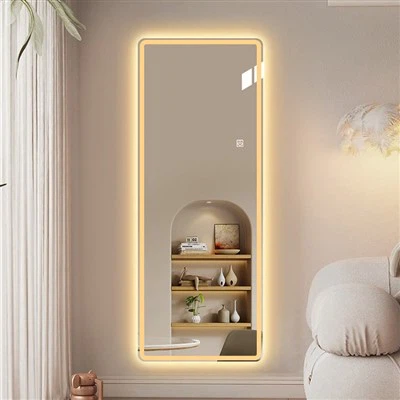
Satin etched glass has a smooth, matte appearance that softens reflections and diffuses light while reducing clear visibility through the glass. Unlike transparent glass, which allows objects to be seen sharply, satin etched glass creates a gently blurred effect with a refined, understated finish. Its appearance is often compared to frosted glass, but the surface can feel more uniform and visually subtle, depending on the product and manufacturing process.
Satin acid etched glass is widely considered for office partitions, interior doors, decorative panels, and privacy screens. It offers designers a way to maintain a bright, open atmosphere without relying entirely on solid walls or opaque materials. For architects, contractors, and procurement teams, understanding its appearance, privacy characteristics, and fabrication requirements helps determine whether it is suitable for a particular project.
What Does Satin Etched Glass Look Like?
Satin etched glass typically has a translucent, satin-like surface with a soft, even finish. Light passes through the glass but scatters as it travels through the treated surface. This reduces sharp reflections and makes objects on the other side appear blurred rather than clearly defined.
Its visual character can be described through four main features:
Matte surface: The glass has a soft, low-gloss appearance instead of the clear, highly reflective look of untreated glass.
Diffused light: Natural or artificial light passes through the panel in a softened form, helping interiors feel bright without providing a clear view through the glass.
Subtle visual privacy: Shapes and movement may remain visible, but fine details are less distinct. The actual privacy level depends on lighting, distance, and the specific glass finish.
Clean, contemporary appearance: The restrained surface works well with metal, wood, stone, and other materials commonly used in modern interiors.
Satin etched glass is not necessarily opaque. It is designed to soften visibility, so it should not automatically be treated as a complete visual barrier. Where stronger privacy is required, project teams should review a physical sample under realistic lighting conditions.
How Is Satin Acid-Etched Glass Different from Ordinary Frosted Glass?
The term frosted glass describes an appearance, while acid etching refers to a surface-treatment method. Satin acid etched glass is produced by treating the glass surface with an acid-based process to create a matte finish. Other products described as frosted glass may use sandblasting, applied films, or different manufacturing techniques.
The resulting appearance varies with the production method, glass composition, and finish specification. Some products have a fine, uniform satin appearance, while others have a more visibly textured surface.
| Feature | Satin acid-etched glass | Clear glass | Applied frosted film |
|---|---|---|---|
| Appearance | Smooth, matte, translucent | Transparent and reflective | Depends on film type and installation |
| Light transmission | Light is diffused | Clear light transmission | Depends on film opacity |
| Visibility | Objects appear blurred | Objects are generally visible clearly | Depends on film finish |
| Surface construction | Treated glass surface | Untreated glass surface | Film applied to glass |
| Maintenance | Follow product-specific cleaning guidance | Standard glass cleaning | Film may require film-compatible care |
This comparison is a general guide rather than a guarantee of performance. Different glass products can have different optical characteristics, so samples and technical specifications should be reviewed before final selection.
Do You Know What Is Frosted Glass? Related Post: "What Is Frosted Glass"
Request a custom quote for your glass project
What Is Satin Etched Obscure Glass?
Satin etched obscure glass combines a satin-like surface with a level of visual screening intended to reduce visibility through the panel. The term obscure glass is commonly used for glass that limits clear views, although its precise meaning can vary between suppliers and product ranges.
Satin etched obscure glass may be suitable when a project needs both a restrained appearance and a degree of privacy. Instead of introducing a strong embossed pattern, it uses a diffuse finish that can complement minimalist interiors.
Typical applications include office meeting rooms, internal partitions, cabinet doors, changing areas, and selected bathroom installations. The degree of obscurity depends on the particular product, viewing distance, and lighting conditions.
For areas requiring greater privacy, designers should not rely on the product name alone. A panel may still reveal silhouettes or movement, especially when one side is more brightly illuminated than the other. Reviewing a sample in the intended setting is a practical way to judge whether the finish meets the project's needs.
Satin Etched Obscure Glass Vs Acid-Etched Glass→ Related Post: "What Is Acid-etched Glass"
Where Can Satin Etched Glass Be Used?
The understated appearance of satin etched glass makes it suitable for many interior and selected architectural applications. Its suitability depends on the required privacy, exposure conditions, glass construction, and installation method.
Office Partitions and Meeting Rooms
Satin etched glass can divide workspaces while allowing diffused daylight to pass between areas. It is often considered for meeting-room partitions, private offices, and collaborative spaces where designers want visual separation without creating a heavy, enclosed appearance.
For larger installations, consistent finish and dimensions are important. Teams should confirm panel sizes, edgework, hardware interfaces, and any required safety-glazing specifications before production.
Interior Doors and Screens
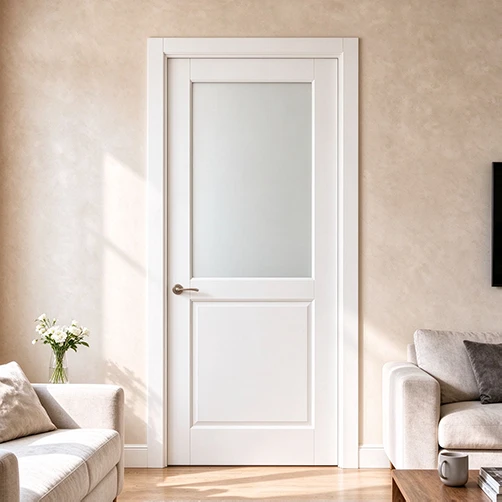
In offices, hotels, and residential interiors, satin etched glass can provide a softer alternative to clear glazing for doors and screens. Its neutral appearance coordinates with a variety of frame finishes and interior materials.
The correct glass construction should be selected according to the door design, panel dimensions, impact risks, and applicable building requirements.
Bathroom and Changing Areas
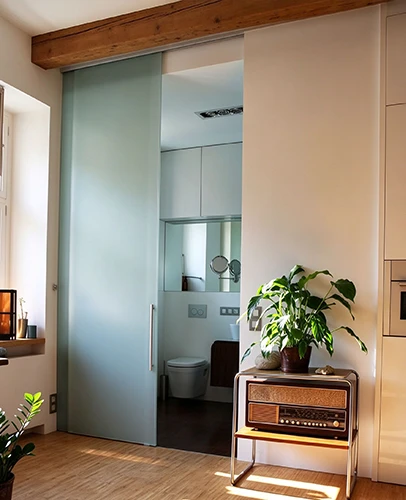
Satin etched glass may be used for bathroom partitions, privacy screens, and some shower applications. However, the finish itself does not make glass suitable for wet-area installation. Glass thickness, safety treatment, hardware, water exposure, and installation details must all be evaluated.
Designers should also test the privacy level under the lighting conditions expected in use, particularly where the space requires a higher degree of screening.
Cabinet Doors and Decorative Panels
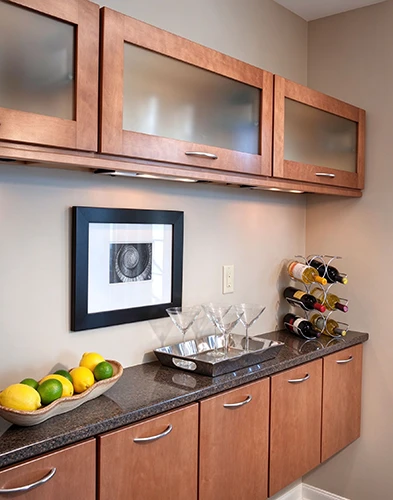
Satin acid etched glass can introduce a soft, contemporary finish to cabinet fronts, display units, and decorative wall panels. It can conceal some of the contents behind a cabinet while maintaining a lighter appearance than a solid door.
For multi-panel cabinetry or feature walls, sample approval helps ensure that the finish, orientation, and visual consistency meet the design requirements.
Learn More About Decorative Glass→ Related Post: "Five Types Of Decorative Glass"
How to Select Satin Acid-Etched Glass Panels
When specifying satin acid etched glass panels, appearance is only one part of the selection process. The glass must also meet dimensional, fabrication, installation, and performance requirements.
1. Define the Required Privacy Level
Start by identifying whether the glass needs to blur objects, reduce direct visibility, or provide a stronger privacy barrier. These are different requirements. Review samples from both sides and under different lighting conditions to determine whether the finish provides the intended effect.
2. Confirm Glass Thickness and Dimensions
Panel thickness and size should be chosen according to the installation, support system, and relevant project requirements. Large panels may require specific handling, edge finishing, or structural considerations. Drawings should clearly show the finished dimensions and any holes, notches, or cutouts.
3. Check Fabrication Compatibility
Not every decorative glass finish is compatible with every subsequent process. Confirm whether the selected glass needs cutting, drilling, tempering, laminating, or other processing, and agree on the manufacturing sequence before production.
Where safety glazing is required, the complete glass product should meet the applicable local standards. Acid etching alone does not make ordinary glass safety glass.
4. Review Appearance and Maintenance
Surface uniformity, cleaning requirements, and the appearance of fingerprints or marks can influence the product's suitability for high-traffic spaces. Ask the supplier for product-specific care instructions and approve a representative sample where appearance consistency is important.
5. Coordinate the Project Specification
For projects involving multiple panels, document the approved finish, thickness, dimensions, edgework, processing requirements, and installation details. A clear specification helps designers, contractors, fabricators, and procurement teams work toward the same result.
Working with Commercial Glass Suppliers
Selecting commercial glass suppliers requires consideration of product suitability, technical communication, production capabilities, and project coordination. The supplier should understand the intended application and be able to clarify which details need to be confirmed before an order is finalized.
Luck Glass supports decorative and architectural glass requirements for project buyers. When discussing satin acid-etched glass, customers can share the intended application, reference images, panel dimensions, preferred finish, and processing needs to help identify suitable options for evaluation.
For larger projects, clear drawings and an approved physical sample can help establish expectations for appearance and fabrication. Requirements for safety glazing, installation, and environmental exposure should be confirmed against the applicable specifications before production.
By clarifying the complete requirements at the start, architects, designers, contractors, and procurement teams can reduce ambiguity and coordinate the selected glass more effectively.
There are Some Excellent Manufacturers⇔ Related Post: "Top 10 Glass Manufacturers in China 2026: A Comprehensive Guide For Businesses"
Frequently Asked Questions
Is satin etched glass transparent or opaque?
Satin etched glass is generally translucent rather than fully opaque. It diffuses light and blurs objects behind the panel, but shapes or movement may still be visible depending on the finish, lighting, and viewing distance.
Does satin etched glass provide privacy?
Yes, it can provide visual screening for partitions, doors, and decorative panels. The level of privacy varies by product and environment, so samples should be evaluated in the intended setting before selection.
Is satin acid-etched glass suitable for shower doors?
It may be suitable when the complete glass construction and shower enclosure meet the applicable safety and installation requirements. The surface finish alone does not determine whether the glass is appropriate for a shower door.
Can satin acid-etched glass be tempered?
Depending on the product, satin acid-etched glass can be supplied in a tempered construction. Cutting, drilling, and edgework generally need to be completed before tempering, so the processing sequence should be confirmed with the supplier.
What should I provide when requesting a quotation for satin etched glass?
Provide the intended application, panel dimensions, thickness, finish requirements, processing details, quantity, and delivery location. Drawings or reference photographs can help the supplier understand the specification more accurately.
Final Thoughts
Satin etched glass has a smooth, matte appearance that diffuses light, softens reflections, and reduces direct visibility while preserving a bright, contemporary feel. It can be used in office partitions, interior doors, decorative panels, and selected privacy applications, provided the finish and complete glass construction meet the project's requirements.
For the best results, define the required privacy level, confirm fabrication and installation details, and review a sample before approving production. Working with a supplier that understands architectural glass requirements can help ensure that the selected panels align with the design intent and practical needs of the project.