Walk through a modern museum, a flagship retail store or a high-end office building and you'll likely encounter glass that seems to disappear. No glare, no reflection, just a clear view through to whatever is on the other side. That's AR coated tempered glass at work - a material that solves two problems at once. It eliminates the annoying reflections that make ordinary glass feel like a mirror, and it does it with the strength and safety certification of fully tempered glass. But what exactly is it, how is it made, and why does the combination matter? Let's break it down.
How Anti-Reflective Coatings Work
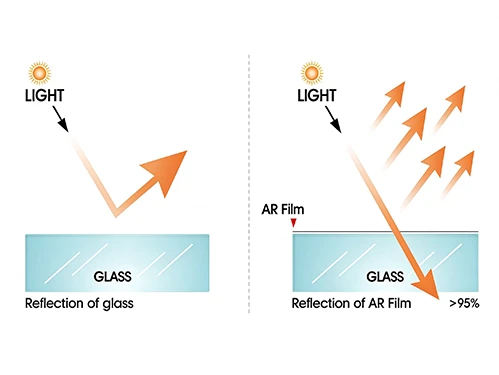
The technology behind AR coatings is the same thin-film interference used in dichroic glass and high-end camera lenses. When light hits a boundary between two materials with different optical densities - like air and glass - some of it reflects. An AR coating introduces one or more intermediate layers between the air and the glass, each with a carefully chosen refractive index and thickness. Light reflecting off the top of the coating and light reflecting off the bottom of the coating travel slightly different distances, so they arrive out of phase and cancel each other out. That cancellation - destructive interference - is what eliminates the reflection.
Thin-Film Interference in Action
A single-layer AR coating can reduce reflection from 4% to about 1.5% per surface, which is noticeable but not dramatic. A multi-layer coating - typically four to seven layers of alternating high and low index materials like titanium dioxide and silicon dioxide - can push that down to under 0.5% per surface, which is where the glass starts to feel genuinely invisible. The layers are deposited in a vacuum chamber using physical vapor deposition: the source materials are heated until they vaporize, the vapor drifts through the vacuum and condenses on the glass, and a quartz crystal monitor tracks each layer's thickness to within a fraction of a nanometer. The entire run takes hours, and the chamber must be brought back to atmospheric pressure before the coated glass can be removed.
The precision required is why AR coated glass has historically been more expensive than ordinary glass. Every layer must be deposited to exact specifications, and the sequence must be identical across every pane in a batch to ensure color and reflection consistency. But for applications where clarity matters - museums, display cases, high-end retail - the difference is immediately visible.
Related post: "How do they make dichroic glass? Manufacturing Process and Dichroic Laminated Glass Explained"
Performance Characteristics
The real value of AR coated tempered glass is in the combination of properties it delivers - properties that neither AR-coated annealed glass nor ordinary tempered glass can achieve alone. Here's how the three compare.
| Property | Ordinary Tempered Glass | AR-Coated Annealed Glass | AR Coated Tempered Glass |
|---|---|---|---|
| Surface reflection | ~8% total | Under 1% total | Under 1% total |
| Light transmission | ~85-90% | ~97-99% | ~97-99% |
| Breakage safety | Shatters into small fragments | Sharp shards | Shatters into small fragments |
| Safety certification | EN 12150 / ANSI Z97.1 | Not safety rated | EN 12150 / ANSI Z97.1 |
| Strength | 4-5x annealed | Standard | 4-5x annealed |
| Suitable for doors/partitions | Yes | No (code violation) | Yes |
| Optical clarity | Good (with glare) | Excellent | Excellent |
The key takeaway is that AR coated annealed glass gives you clarity but not safety, while ordinary tempered glass gives you safety but not clarity. AR coated tempered glass is the only option that delivers both, which is why it's specified for applications where building codes require safety glass and the design requires low reflection. The higher light transmission is a bonus - by eliminating reflection, more light passes through the glass, which can reduce lighting energy use in interior applications.
Related post: "What is Aquatex glass? Pattern, Privacy, Uses and Aquatex Obscure Glass Guide"
Explore AR Coated Tempered Glass
Where AR Coated Tempered Glass Is Used
The combination of low reflection and safety certification opens up applications that neither treatment could serve alone. Across cultural, commercial, corporate and specialty settings, the material solves a problem that ordinary glass can't: delivering unobstructed clarity in spaces where building codes demand safety glass.
Museums and Cultural Institutions
Museums and galleries are the most demanding users of anti-reflective glass, and AR coated tempered glass has become the standard for display cases, viewing windows and gallery partitions. A case holding a Renaissance painting, a handwritten manuscript or a delicate textile needs glass that lets visitors see the work without seeing their own reflection standing between them and the object. At the same time, that glass has to withstand accidental impact from crowds, attempted vandalism and the rigors of daily public access. Ordinary AR-coated annealed glass gives the clarity but fails the safety test; ordinary tempered glass passes the safety code but creates glare that obscures the art. AR coated tempered glass is the only product that satisfies both requirements at once.
Many museum-grade configurations also integrate UV-blocking layers into the coating stack, filtering out up to 99% of ultraviolet radiation that would otherwise fade pigments, paper and textiles over time. That triple performance - low reflection, safety strength, UV protection - makes it a multi-functional solution rather than a single-purpose material. Beyond display cases, museums use it for gallery partitions that separate rooms without visual interruption, and for observation windows in conservation labs where visitors watch restorers at work.
Retail and Commercial Interiors
Retail environments are where AR coated tempered glass does some of its most visible work. A jewelry display case in a luxury boutique, a cosmetic counter in a department store, a watch showcase in an airport terminal - all of these rely on glass that lets merchandise be seen clearly under bright retail lighting, without the window turning into a mirror that reflects the ceiling fixtures and the shopper's own face. The tempered construction means these displays meet the safety codes required for fixtures accessible to the public, and the low-reflection surface makes products look more vibrant, more detailed and more appealing than they would behind ordinary glass.
Storefronts are another major application. A flagship retail store with floor-to-ceiling glass wants passersby to see the merchandise and interior design, not their own reflection staring back. AR coated tempered glass reduces that reflection dramatically while maintaining the safety rating required for ground-floor glazing. Restaurants and cafes use it for display counters and pastry cases, where food needs to look appetizing without the distortion of glare. In every retail setting, the underlying logic is the same: people buy what they can see clearly, and AR coated tempered glass removes the visual barrier that ordinary glass creates.
Specialty and High-Performance Applications
Beyond the standard cultural, retail and corporate uses, AR coated tempered glass shows up in a range of specialty environments where both clarity and safety are non-negotiable. Sports venues use it for VIP boxes and hospitality suites, where spectators want an unobstructed view of the field without glare from stadium floodlights reflecting off the glass. Broadcasting studios use it for control room windows and interview booths, where camera crews need to see through the glass without reflections appearing in the shot - a reflection that's invisible to the naked eye can become glaringly obvious on camera.
Observation decks in towers, aquariums and national parks use it for viewing windows, where visitors want unobstructed panoramas without their own silhouettes reflected in the frame. Aquariums, in particular, benefit from the combination of low reflection and high strength: the glass has to withstand water pressure and impact while letting visitors see marine life clearly. Transportation applications include train and bus station waiting areas, where large glass walls need to be both safe and free of glare. In every one of these specialty cases, the requirement is the same: clarity plus safety, in a single panel that performs reliably for decades.
Related post: "Does obscure glass block light? Light Transmission, Privacy and Autumn Obscure Glass Explained"
Luck Glass: Your AR Coated Tempered Glass and Tempered Glass Manufacturer
Luck Glass is a professional architectural and decorative glass manufacturer producing a full range of coated and tempered products, including AR Coated Tempered Glass, non reflective tempered glass, anti-glare tempered glass, Bronze Anti Sun Glass, dichroic glass, laminated glass, reeded glass, frosted glass, back painted glass and more. The company supplies global anti glare glass supplier networks, toughened glass suppliers, commercial glass manufacturers, custom glass suppliers, building material traders and brand clients, with advanced vacuum coating, tempering, laminating and finishing production lines.
Luck Glass produces AR Coated Tempered Glass with multi-layer anti-reflective coatings formulated to withstand the tempering process, delivering residual reflection as low as 0.5% per surface while maintaining full EN 12150 and ANSI Z97.1 safety certification. Light transmission reaches 97-99%, and optional UV-blocking layers can be added for museum and artifact protection. All AR coated tempered glass can be customized across thickness (4mm-12mm), coating side (one or both sides), panel size, edge finishing, hole drilling and cutouts, with maximum panel sizes up to 3660mm x 2440mm.
Whether the project calls for AR coated tempered glass for museum display cases, anti-glare tempered partitions for a corporate office, low-reflection storefront glass for a retail flagship, or bulk supply from a tempered glass company for a large-scale development, Luck Glass delivers consistent coating and tempering quality, technical support on optical performance and safety compliance, and reliable lead times for both sample orders and full-container shipments.
Frequently Asked Questions
Q: What is AR coated tempered glass?
A: AR coated tempered glass is glass that has been both treated with a multi-layer anti-reflective (AR) coating to reduce surface reflection from 8% to under 1%, and fully tempered to meet safety glass standards. It combines near-invisible optical clarity with four-to-five times the strength of ordinary glass, and it shatters into small blunt fragments when broken.
Q: How does the AR coating work?
A: The AR coating uses thin-film interference. Multiple nanometer-thin layers of metal oxides (titanium dioxide, silicon dioxide and others) are deposited onto the glass in a vacuum chamber. Light reflecting off different layers travels different distances and cancels out through destructive interference, eliminating most of the surface reflection.
Q: Can AR coating be applied after tempering?
A: Yes, but it depends on the coating technology. Some AR coatings are formulated to be applied before tempering and survive the 700°C heat; others are applied after tempering using low-temperature processes. A reputable tempered glass manufacturer will validate the coating-tempering sequence and provide both optical and safety test reports.
Q: Is AR coated tempered glass the same as anti-glare glass?
A: Not exactly. AR (anti-reflective) glass uses precision coatings to reduce actual reflection through light interference, preserving optical clarity. Anti-glare (AG) glass uses a textured surface to scatter reflection into a diffuse glow, which reduces glare but can slightly soften the view. Both are available in tempered versions, and an anti glare glass supplier can help specify the right one.
Q: What are the main applications for AR coated tempered glass?
A: Museum display cases, gallery partitions, retail storefronts and display cases, office conference room partitions, sports venue VIP boxes, broadcasting studios, observation decks, and any application where both low reflection and safety glass certification are required.
Related post: "Is there a way to make glass non-reflective? Methods, Applications and Bronze Anti Sun Glass Guide"
Final Thoughts
AR coated tempered glass is one of those materials that doesn't get much attention until you need it - and once you've seen it, ordinary glass feels like a compromise. The anti-reflective coating does what it promises: it makes the glass nearly disappear, so you see what's on the other side instead of your own reflection. The tempering does what it promises: it makes that same glass strong enough and safe enough to use in doors, partitions and display cases where building codes demand safety glass. Neither treatment is new, but getting both to work together on the same panel - without the coating cracking in the tempering oven or the tempering compromising the optical performance - is the manufacturing challenge that separates a reliable product from a disappointing one. For museums, retailers, architects and anyone who's ever fought with a reflective window, that combination is worth getting right.
Related post: "Is there glass that doesn't reflect? Non Reflective Tempered Glass for Safety and Clarity"