It's one of the most common questions people ask when choosing glass for a bathroom, office or partition: does obscure glass block light? The short answer is no - but the full answer is more interesting, and it matters more than most people realize. Obscure glass doesn't stop light from passing through. It changes how that light behaves, scattering it into a soft, even glow rather than letting it travel in a straight line. That single difference is what makes obscure glass both private and bright at the same time.
Does Obscure Glass Actually Block Light?
No. Obscure glass transmits the vast majority of the light that hits it. What it blocks is clarity - the ability to see a clear image through the pane. A clear glass window lets you see everything on the other side, and it lets light pass through in straight lines. An obscure glass window lets almost the same amount of light through, but that light gets bounced around by the surface texture, so what comes out the other side is diffused and even rather than sharp and directional.
Scattering vs. Blocking
The distinction between scattering and blocking is the whole game. A material that blocks light - a wall, a curtain, an opaque panel - absorbs or reflects it, so the space behind stays dark. A material that scatters light - frosted glass, patterned glass, reeded glass - lets the light through but randomizes its direction. The result is a space that feels bright and open, even though you can't see through it.
That's why a bathroom with obscure glass windows can feel flooded with daylight while still keeping the bather completely private. The light comes in; the view doesn't. It's also why obscure glass partitions in offices keep workspaces feeling connected and bright, even when they're separating private offices or meeting rooms.
Related post: "Can you see through reeded glass? Reeded Glass Privacy, Pattern and Application Guide"
How Obscure Glass Works
Obscure glass gets its light-scattering property from a surface texture. That texture can be created in a few different ways - acid etching, sandblasting, or rolling the glass through patterned rollers while it's still molten - but the principle is the same in every case. The uneven surface catches light rays and sends them off in new directions, like a handful of tiny mirrors angled in random directions.
The Science of Light Diffusion
When light hits a smooth, clear glass surface, most of it passes straight through with its direction unchanged. That's why you can see a sharp image through clear glass. When light hits an obscure glass surface, the bumps and grooves on the surface refract each ray at a slightly different angle. The rays still go through - they just no longer travel in parallel. By the time they exit the other side, they're moving in so many different directions that they can't reassemble into a coherent image. What you get instead is a soft, uniform glow.
The depth and density of the surface texture determine how much diffusion happens. A light, fine texture scatters light gently - you'll see blurred shapes and movement through it. A deep, dense texture scatters light aggressively - you'll see nothing but light. Most obscure glass sits somewhere in between, offering enough privacy for bathrooms and offices while still transmitting 60-85% of incoming daylight.
Related post: "How obscure is satin glass? Privacy Performance and Application Guide for Commercial Projects"
Light Transmission by Pattern Type
Not all obscure glass transmits the same amount of light. The pattern, the texture depth, and whether the glass is tinted all play a role. Here's how the main categories compare.
| Glass Type | Typical Light Transmission | Privacy Level | Best For |
|---|---|---|---|
| Clear glass | 85-90% | None | Unobstructed views |
| Light frosted | 75-85% | Medium | Office partitions |
| Reeded / ribbed | 70-80% | Medium | Doors, partitions |
| Patterned (autumn, bamboo, basketweave) | 65-80% | Medium-high | Bathrooms, feature panels |
| Heavy frosted | 50-70% | High | Shower enclosures |
| Tinted obscure | 30-60% | High | South-facing windows |
| Opaque | Under 10% | Total | Privacy-only panels |
Frosted vs. Patterned vs. Tinted
Frosted glass has a uniform matte surface with no discernible pattern. It's the most consistent light diffuser - every part of the pane scatters light equally - and it tends to transmit a high percentage of daylight because the texture is relatively fine. Patterned glass - reeded, bamboo, autumn, basketweave - has a raised or recessed design that scatters light in a more directional way. Some patterns transmit slightly less light than frosted because the deeper parts of the pattern catch more light, but the difference is usually small. Tinted obscure glass adds a color layer - grey, bronze, blue - that absorbs some light in addition to scattering it. Tinted glass is the right choice when you need both privacy and glare control, but it does come at the cost of some brightness.
For most interior applications - doors, partitions, shower enclosures - a clear-based frosted or patterned obscure glass is the best choice. It gives you privacy without sacrificing the light that makes a space feel livable.

Autumn Obscure Glass: A Closer Look
Among the patterned obscure glasses, Autumn Obscure Glass occupies a distinctive spot. Its pattern draws on organic, leaf-like forms - curved lines, rounded shapes, a flowing rhythm that evokes falling leaves and autumn foliage. Unlike a strict geometric pattern like basketweave or Contora, autumn pattern feels natural and warm, with a softness that complements both traditional and contemporary interiors.
Pattern and Light Performance
Autumn Obscure Glass typically transmits 65-80% of incoming daylight, depending on the pattern depth and glass thickness. Its organic forms scatter light in a gentle, uneven way, creating a dappled, leaf-dappled effect that feels more natural than the uniform diffusion of frosted glass. In direct sunlight, an autumn pattern window casts soft, organic shadows that move throughout the day - a subtle decorative effect that plain frosted glass can't match.
The pattern also offers medium-to-high privacy. You won't see clear details through it, though you will see movement and light, which makes it suitable for obscure glass for bathroom window applications, shower glass doors frosted alternatives, and interior partitions. It pairs particularly well with timber frames, warm metal finishes like brass and bronze, and natural materials like stone and wood.
For commercial projects, Autumn Obscure Glass is a strong choice for hospitality interiors - hotel bathrooms, restaurant booth dividers, spa treatment rooms - where a warm, natural pattern adds atmosphere without overwhelming the design. It also works well in residential developments, where buyers increasingly look for character and detail rather than plain frosted glass.
Related post: "What are some different types of glass patterns? A Visual Guide to Textures, Privacy and Bamboo Pattern Glass"
Where Obscure Glass Works Best
Obscure glass is one of the most versatile materials in modern construction, and its ability to transmit light while protecting privacy is the reason it shows up in so many different spaces.
Bathrooms are the classic home for obscure privacy glass. A bathroom window made of obscure glass lets in daylight while keeping the interior private from neighbors or passersby. Shower glass doors frosted or patterned provide the same balance inside the wet room - bright, open, and private. For bathrooms that get strong direct sun, a lightly tinted obscure glass can add glare control without making the room feel dark.
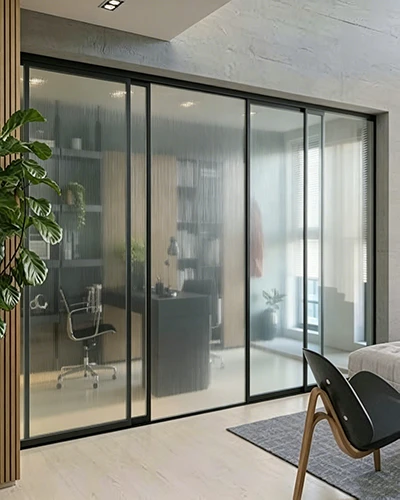
Office partitions are another major application. A glass partition supplier will often specify obscure glass for meeting rooms, private offices and quiet zones, where the goal is to separate spaces acoustically and visually without creating a closed-off, walled-in feeling. Obscure glass partitions keep daylight moving across an open floor plate while giving meeting participants the privacy they need.
Interior doors - pantry doors, closet doors, bedroom doors - benefit from obscure glass for the same reason. They bring light into hallways and rooms that would otherwise feel dark, while keeping the space behind the door private. A patterned obscure glass like Autumn Obscure Glass adds a decorative layer that a plain frosted door can't match.
Related post: "What is the most popular obscure glass pattern? Top Privacy Patterns for Commercial Projects"

Luck Glass: Your Obscure Glass and Autumn Pattern Partner
Luck Glass is a professional decorative glass manufacturer producing a wide range of obscure and patterned glass, including Autumn Obscure Glass, frosted glass, reeded glass, rain glass, wavy glass, bamboo pattern glass, basketweave glass, Florentine glass, Contora glass, Karatachi glass, back painted glass and laminated glass. The company supplies global glass supply company clients, wholesale window glass suppliers, glass partition supplier networks, building material traders and brand clients, with advanced rolling, tempering, laminating and finishing production lines.
Luck Glass offers obscure privacy glass in dozens of pattern families and privacy levels, including the full autumn pattern range - light autumn, standard autumn and deep autumn - with pattern depths and glass thicknesses to match specific design requirements. All obscure glass can be tempered to EN 12150 and ANSI Z97.1 safety standards, laminated for security and acoustic performance, or assembled into double glazed units for thermal efficiency. Full customization is supported across size, thickness, pattern selection, tint depth, edge finishing, hole drilling and cutouts, with maximum panel sizes up to 3660mm x 2440mm and typical delivery within 25 working days.
Whether the project calls for obscure glass for bathroom window installations in a residential development, shower glass doors frosted alternatives for a hotel fit-out, Autumn Obscure Glass for a boutique retail interior, or bulk supply from wholesale window glass suppliers for a large-scale commercial build, Luck Glass delivers consistent batch quality, technical support on pattern orientation and safety compliance, and competitive pricing for both sample orders and full-container shipments.
Frequently Asked Questions
Q: Does obscure glass block light?
A: No. Obscure glass doesn't block light - it scatters it. Most obscure glass transmits 60-85% of incoming daylight, depending on the pattern and texture depth. What it blocks is clarity, so you can't see a clear image through it, but the space behind still feels bright and open.
Q: What is Autumn Obscure Glass?
A: Autumn Obscure Glass is a patterned obscure glass with organic, leaf-like forms that evoke falling leaves and autumn foliage. It transmits 65-80% of daylight, offers medium-to-high privacy, and casts soft, dappled shadows in direct sunlight. It's commonly used in bathrooms, shower enclosures, interior doors and hospitality interiors.
Q: Which obscure glass lets through the most light?
A: Light frosted glass and fine reeded glass typically transmit the most light - 75-85% - because their textures are relatively fine. Patterned glasses like autumn, bamboo and basketweave transmit slightly less (65-80%) because their deeper patterns scatter more light. Tinted obscure glass transmits the least (30-60%) because the color layer absorbs light in addition to scattering it.
Q: Can obscure glass be used for shower doors?
A: Yes. Obscure glass is one of the most common choices for shower glass doors, both frosted and patterned. It provides privacy while letting light into the shower area, and it can be tempered for safety. Autumn Obscure Glass and other patterned options add a decorative element beyond plain frosted.
Q: Is obscure glass the same as frosted glass?
A: Frosted glass is a type of obscure glass, but not all obscure glass is frosted. Frosted glass has a uniform matte surface with no pattern. Obscure glass is a broader category that includes frosted, reeded, patterned (autumn, bamboo, basketweave), tinted and other textured glasses. All of them scatter light and protect privacy, but they do it with different surface textures and decorative effects.
Related post: "What is a basketweave pattern? Origins, Uses and Basketweave Glass Guide"
Final Thoughts
The question "does obscure glass block light?" comes from a reasonable place - people assume that if you can't see through something, it must be keeping light out. But that's not how obscure glass works. It doesn't block light; it redirects it, turning sharp, directional rays into a soft, even glow that fills a space without revealing what's on the other side. That's the magic of it, and it's why obscure glass has been a staple of architecture for well over a century.
Autumn Obscure Glass takes that fundamental property and adds a layer of natural, organic decoration. Its leaf-like forms scatter light in a dappled, gentle way, casting moving shadows throughout the day and adding warmth to any space. It's private enough for a bathroom, bright enough for an office, and decorative enough for a feature panel. When you're choosing obscure glass, remember that you're not choosing between light and privacy - you're choosing how the light gets delivered. Pick the pattern that delivers it the way your space needs.