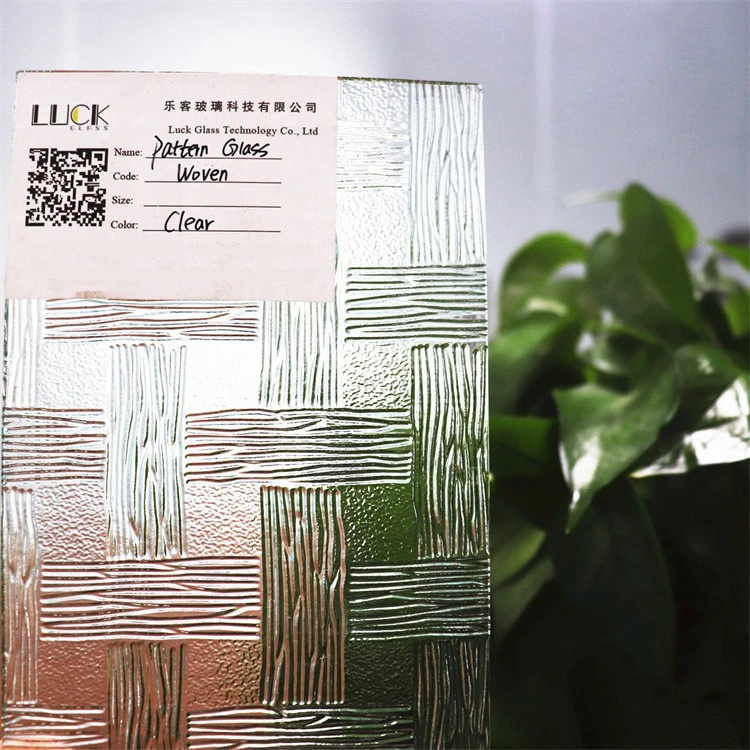
Walk into any well-curated interiors showroom and you'll see it - a glass surface crisscrossed with interlocking bands that read like the side of a woven basket. It's basketweave, and it's been around longer than most people realize. Unlike reeded glass, which leans modern and linear, or rain glass, which feels organic and drippy, basketweave sits somewhere in between - structured enough for a commercial lobby, warm enough for a residential bathroom. It's a pattern that quietly earns its place.
What Is a Basketweave Pattern?
At its simplest, a basketweave pattern is made of two sets of parallel bands that cross  over and under each other, mimicking the weave of a traditional wicker basket. In glass, that means the surface is pressed with raised and recessed rectangular or square strips that interlock. The result reads as a grid, but a grid with depth - you can see which band passes over and which passes under, and that subtle over-under illusion is what gives the pattern its name.
The Visual Language of Basketweave
What makes basketweave distinctive is its rhythm. Reeded glass moves in one direction; Florentine glass scatters in diamonds; basketweave moves in two directions at once, creating a checkerboard of woven rectangles. It reads as orderly without being sterile, and as decorative without being fussy. The pattern can be rendered with wide bands for a bold, graphic look, or with narrow bands for a finer, more delicate texture. Both versions share the same DNA - interlocking strips, over-under movement, a quiet sense of craft.
Because the pattern is geometric and repetitive, it scales well. A small sample and a full-size panel read the same way, which makes batch matching across a large project straightforward. It also means the pattern works at close range and from a distance - up close you see the weave detail, from across a room you see a textured, light-diffusing surface.
Related post: "What Does Contora Glass Look Like? Visual Guide To Contora Pattern Glass"
A Brief History of Basketweave in Glass and Design
Basketweave isn't a glass invention - it's a textile and craft pattern that migrated into glass. Woven baskets date back thousands of years, and the over-under weave is one of the most fundamental structures in basketry, textiles and wickerwork. By the Victorian era, that familiar weave had started showing up in pressed glass tableware, tiles and architectural glazing.
From Woven Baskets to Pressed Glass
The late 19th century saw an explosion in pressed glass patterns. Factories could roll molten glass through patterned rollers, and designers borrowed freely from the decorative vocabulary around them - florals, geometrics, classical motifs and, of course, basketweave. The pattern appealed to Victorian and Edwardian tastes because it evoked handcraft and natural materials at a time when industrial production was accelerating. A basketweave glass door felt artisanal even when it came off a factory line.
Through the Art Deco period, basketweave got bolder and more geometric, pairing well with the era's love of stepped forms and repeating motifs. It faded somewhat in the mid-century modern period, when clear glass and minimalism dominated, but it's been quietly making a comeback. Today's designers are drawn to it for the same reason their Victorian predecessors were - it adds texture and craft without shouting, and it works equally well in traditional and contemporary settings.
Basketweave Glass: Privacy and Light Performance
Like all patterned glass, basketweave is a privacy material first and a decorative material second. The raised and recessed bands scatter light as it passes through, breaking up sight lines while letting daylight move through the pane.
How It Compares to Other Patterns
Basketweave sits in the middle of the privacy spectrum. It's more obscuring than a light reeded or a fine hammered pattern, but less total-privacy than a heavy frosted or a deep Karatachi. You won't see clear details through it, but you will see movement and light - which is exactly what most interior applications want. It diffuses light evenly, without the hotspots that some deep patterns can create, and it doesn't cast strong shadows the way a bold reeded can in direct sunlight.
For commercial projects, that middle-ground privacy is often the sweet spot. An office partition needs to separate spaces without making either side feel closed off. A restaurant booth divider needs to feel intimate without feeling walled in. A shower enclosure needs privacy without sacrificing the sense of space. Basketweave handles all of those comfortably.
Related post: "Can you see through reeded glass? Reeded Glass Privacy, Pattern and Application Guide"
Where Basketweave Glass Works Best
Basketweave's versatility is one of its strongest selling points. It shows up in almost every room type, and it pairs with a wide range of frame materials and interior styles.
Doors and Door Lites
Interior doors, pantry doors, closet doors and front door sidelights are natural homes for basketweave. The pattern brings daylight into hallways and rooms while keeping the other side private, and its geometric character reads well in both timber and steel frames. It's a particularly strong choice for period restoration projects, where a historically appropriate pattern matters.
Partitions and Screens
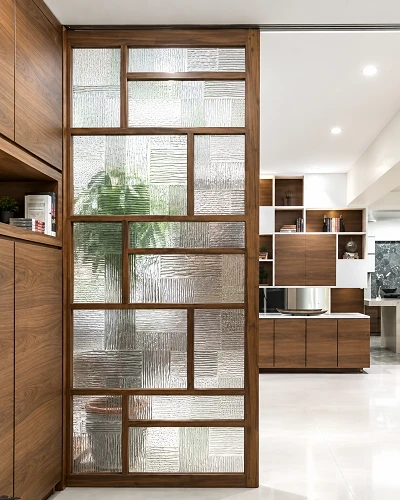
Glass partition manufacturers increasingly specify basketweave for office dividers, restaurant booth screens and residential room separators. The two-directional weave gives the surface more visual interest than a single-direction reeded, and it softens sight lines without killing daylight. For open-plan offices that need quiet zones without building walls, basketweave partitions are a reliable choice.
Bathrooms and Wet Areas
Shower enclosures and bathroom windows are the classic home for patterned glass, and basketweave holds its own here. Patterned shower glass with a basketweave texture adds a decorative layer that plain frosted can't match, while still delivering the privacy a shower needs. It pairs beautifully with subway tile, marble, brass fixtures and black steel frames.
Cabinetry and Furniture
Display cabinets, wardrobes and built-in shelving all benefit from basketweave. It hides clutter on the shelves behind while letting you read the colors and shapes of what's stored, and the woven texture adds a craft feel to built-in joinery. It's a pattern that works as well on a cabinet front as it does on a full-height partition.
Related post: "What are the different types of patterned glass? Types, Uses and Karatachi Glass Guide"
Sourcing Basketweave Glass for Commercial Projects
For multi-unit residential, hospitality or commercial fit-outs, sourcing matters as much as the pattern itself.Ask whether the supplier rolls its own patterns or buys from another factory. In-house rolling gives you tighter quality control, faster pattern matching and the ability to produce custom basketweave variations - wider bands, narrower bands, different rectangle proportions. Check whether they can temper, laminate and double glaze in-house, and whether they offer full-size samples rather than tiny swatches. For commercial orders, ask about batch matching, lead times and packaging for export.
Working with a glass supply company that handles full container loads gives you the best per-square-meter pricing on patterned glass panels. For one-off design pieces or custom textures, pattern glass suppliers that work directly with designers can develop bespoke patterns and finishes. A reliable supplier will also handle cutting, edge finishing, hole drilling and cutouts in-house, which reduces handling damage and keeps lead times predictable.
Related post: "What is the most popular obscure glass pattern? Top Privacy Patterns for Commercial Projects"
Luck Glass: Your Basketweave Glass and Patterned Glass Partner
Luck Glass is a professional decorative glass manufacturer producing a wide range of patterned and textured glass, including Basketweave Glass, reeded glass, rain glass, wavy glass, Everglade glass, Florentine glass, Contora glass, Karatachi glass, frosted glass, back painted glass and laminated glass. The company supplies global pattern glass suppliers, wholesale window glass suppliers, custom glass suppliers, wholesale glass manufacturers, building material traders and brand clients, with advanced rolling, tempering, laminating and finishing production lines.
Luck Glass offers patterned glass panels in dozens of pattern families and privacy levels, including the full basketweave range - fine weave, standard weave and bold weave - with band widths and rectangle proportions to match specific design requirements. All patterned glass can be tempered to EN 12150 and ANSI Z97.1 safety standards, laminated for security and acoustic performance, or assembled into double glazed units for thermal efficiency. Full customization is supported across size, thickness, pattern selection, edge finishing, hole drilling and cutouts, with maximum panel sizes up to 3660mm x 2440mm and typical delivery within 25 working days.
Whether the project calls for patterned shower glass for a hotel fit-out, basketweave glass for a residential development, decorative glass patterns for a boutique retail interior, or bulk supply from commercial glass manufacturers for a large-scale build, Luck Glass delivers consistent batch quality, technical support on pattern orientation and safety compliance, and competitive pricing for both sample orders and full-container shipments.
Frequently Asked Questions
Q: What is a basketweave pattern in glass?
A: A basketweave pattern is a pressed glass texture made of two sets of parallel bands that cross over and under each other, mimicking the weave of a traditional wicker basket. The interlocking rectangular or square strips create a geometric, light-diffusing surface that offers privacy while letting daylight through.
Q: Is basketweave glass private?
A: Yes, basketweave glass offers medium-to-high privacy. The interlocking bands scatter light and break up sight lines, so you won't see clear details through it, though you will see movement and light. It's more obscuring than a fine reeded or hammered pattern, but less total-privacy than a heavy frosted.
Q: Where is basketweave glass commonly used?
A: Basketweave glass is used in interior doors, pantry doors, office partitions, restaurant booth dividers, shower enclosures, bathroom windows, display cabinets and wardrobes. Its geometric character and medium privacy make it versatile across residential, hospitality and commercial projects.
Q: Can basketweave glass be tempered?
A: Yes. Virtually all rolled patterned glass, including basketweave, can be tempered, laminated or made into double glazed units without losing the surface pattern. Tempering is recommended for doors, shower enclosures and any glazing at low level.
Q: Is basketweave glass still in style?
A: Yes. After fading in the mid-century modern period, basketweave has been making a steady comeback. Designers are drawn to its craft feel, geometric versatility and ability to work in both traditional and contemporary interiors. It's a pattern with history that still feels current.
Related post: "What is Florentine glass? Vintage Florentine Pattern Glass Guide for Restoration and Commercial Projects"
Final Thoughts
Basketweave is one of those patterns that feels familiar even when you can't name it. It's the weave on a wicker basket, the grid on a vintage tile, the texture on a pressed-glass door - and in glass, it brings all of those associations together. It's orderly without being cold, decorative without being fussy, private without being dark.
That balance is why it's lasted. A pattern that's too bold dates quickly; a pattern that's too subtle disappears. Basketweave sits in the middle, quietly doing its job - diffusing light, softening sight lines, adding a touch of craft - and it's been doing it for well over a century. Whether you're fitting out a hotel, partitioning an office, or updating a residential bathroom, basketweave glass is worth a second look.