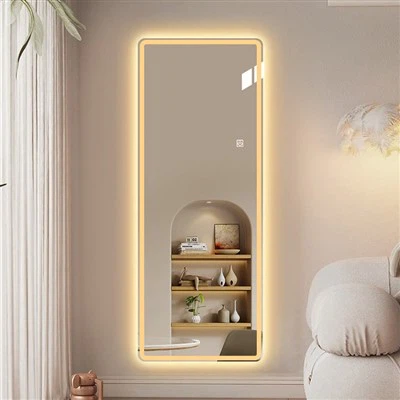
Walk into any glass showroom and you'll face a wall of samples with names that sound more like a coffee menu than building materials - reeded, rain, wavy, hammered, nashiji, florentine, everglade, driftwood. Each one diffuses light and blurs the view in its own way, but they don't all feel the same, look the same, or belong in the same room. Understanding the main families of textured glass - and what makes each one tick - is the fastest way to stop guessing and start specifying with confidence.
What Is Textured Glass?
Textured glass (also called patterned glass or obscure glass) is any flat glass with a raised or pressed pattern on its surface. The pattern breaks up light and sight lines, turning a fully transparent pane into something that admits daylight while protecting privacy. Most modern textured glass is made by feeding molten glass through patterned rollers during production, which presses the texture into the surface while the glass is still hot.
That matters because the pattern is integral to the glass itself. It isn't a film, a coating or a paint job - it can't peel, bubble, fade or scratch off. It can be tempered, laminated, cut and polished just like ordinary clear glass, which is why it shows up everywhere from shower screens and front doors to office partitions and shop fronts.
Textured glass is usually classified by the pattern family it belongs to, and within each family there are variations in depth, density and line direction. Privacy levels range from "you can see vague shapes" to "you see nothing but light," and choosing the right one depends on where the glass goes and how much visual separation you actually need.
Related post: "What is the most popular obscure glass pattern? Top Privacy Patterns for Commercial Projects"
The Main Types of Textured Glass
There are dozens of trade names in the market, but most of them fall into a handful of recognizable pattern families. Getting familiar with these is 90% of the battle.
Reeded and Ribbed Glass
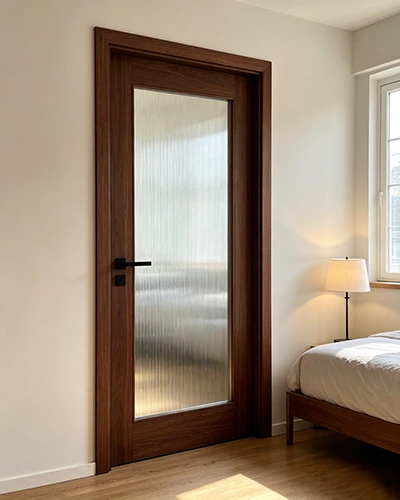
Reeded (or ribbed/fluted) glass has parallel vertical grooves running along the sheet. It's the most architectural of the common patterns - clean, linear and modern. Reeded glass blurs views from side to side more than front to back, which makes it a favorite for doors and screens where you want light through but not identity. It reads as contemporary and pairs beautifully with slim black steel frames.
Rain Glass
Rain glass has irregular vertical drips that look like water running down a window. It's warmer and more organic than reeded glass, with a slightly retro character. It offers solid privacy and hides water spots well, which is why it's long been a bathroom classic. Used thoughtfully with modern frames, rain glass feels current rather than dated.
Wavy and Everglade Glass
Wavy glass has irregular, horizontal, water-like ripples across the surface. Its modern counterpart, Everglade, refines that idea into softer, more controlled undulations. Both feel natural and contemporary - less retro than rain, less geometric than reeded. They diffuse light evenly and look calm across large partition walls.
Hammered and Pebble Glass
Hammered (or pebble, ice) glass has random, shallow dimples across the surface, like frost on a window or pebbles seen through water. It scatters light in many directions and reads as casual and relaxed. It's a popular choice for bathroom windows and cabinet doors where you want privacy without a strong directional texture.
Frosted and Acid-Etched Glass
Frosted glass isn't rolled with a pattern - it's etched or sandblasted uniformly to a milky, matte finish. It offers the most consistent privacy of any textured glass and looks minimal and clean. The trade-off is that it has no decorative pattern of its own, so it reads as plain rather than characterful.
Florentine and Geometric Pattern Glass
Florentine glass belongs to a group of pressed geometric patterns - diamonds, grids, squares - that have a vintage, heritage feel. These are often chosen for period restoration, cabinet fronts and doors where a traditional look matters more than a modern one.
Driftwood Pattern Glass
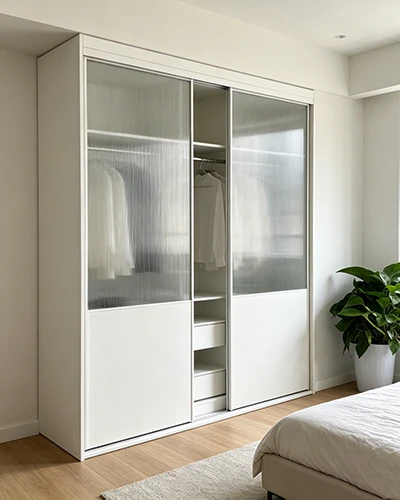
Driftwood pattern glass takes its name from weathered timber. The surface carries long, irregular, vertical-ish textures that recall the grain of bleached driftwood - soft, organic and natural, with a tactile, wood-like character. It sits somewhere between reeded and rain in feel: it has a directional flow like reeded glass, but the lines are irregular and hand-drawn rather than uniform. It suits warm, natural interiors - Japandi, coastal, wabi-sabi, mid-century - and works particularly well on doors, wardrobe fronts, room dividers and feature screens. It diffuses light softly, offers medium-high privacy, and brings a sense of material warmth that flat frosted glass can't match.
Related post: "What is Everglade glass? Modern Everglade Pattern Glass Guide for Doors, Partitions and Wet Areas"
How to Choose the Right Textured Glass
Once you know the families, the decision usually comes down to three things: how much privacy you need, what style you're going for, and where the glass actually goes. The comparison below runs through the most common patterns side by side.
| Pattern | Privacy | Light diffusion | Style | Best for |
|---|---|---|---|---|
| Reeded | Medium | Directional | Modern, linear | Doors, partitions, cabinets |
| Rain | Medium-high | Streaky | Warm, retro | Bathrooms, doors, windows |
| Wavy / Everglade | Medium | Soft, even | Natural, calm | Showers, screens, walls |
| Hammered | Medium-high | Broken, sparkly | Casual, relaxed | Bathrooms, cabinets |
| Frosted / Etched | High | Uniform, milky | Minimal | Windows, doors, partitions |
| Florentine / Geometric | Medium-high | Sparkling | Vintage, heritage | Cabinets, doors, restoration |
| Driftwood | Medium-high | Soft, organic | Natural, tactile | Doors, wardrobes, screens |
A few rules of thumb help narrow it down. If the glass goes in a shower or a bathroom window, lean toward patterns that hide water spots - rain, hammered and driftwood all do this well. If it's a large partition wall in a modern office, reeded or Everglade keeps the look clean and architectural. If the project leans traditional or coastal, driftwood and Florentine add the right amount of warmth. If you need maximum privacy with the least decorative noise, frosted or acid-etched is the straightforward choice.
Whatever pattern you pick, remember that textured glass rarely drops total light transmission by more than 15-25%. What changes is the quality of the light and the level of obscurity, not the brightness of the room.
Related post: "Can you see through reeded glass? Reeded Glass Privacy, Pattern and Application Guide"
Where to Use Textured Glass
Textured glass has become one of the most flexible materials in modern interiors. It's no longer just a bathroom product - it shows up in almost every room.
Doors and Door Lites
Front doors, internal doors, pantry doors and wardrobe doors are the single biggest use of textured glass. They bring daylight into hallways and rooms that would otherwise feel dark, while keeping the other side private. Driftwood pattern glass, in particular, has become a favorite for internal doors and wardrobe fronts because its wood-like texture reads as a design feature rather than a compromise.
Partitions and Screens
Glass partition manufacturers increasingly specify textured glass for office dividers, restaurant booth dividers and residential room screens. It lets light travel across a floor plate and keeps sight lines soft - people know someone is there, but they can't read what's on the monitor. Commercial glass suppliers now stock a wide range of patterns for this exact use.
Bathrooms and Wet Areas
Shower enclosures, bathroom windows and bath screens are the classic home for textured glass. Any pattern from rain to driftwood to hammered works; the main requirements are privacy, moisture resistance and (in showers) tempered safety glass.
Cabinetry and Furniture
Display cabinets, wardrobes, sideboards and built-in shelving all benefit from textured glass. It hides clutter on the shelves behind while letting you see the colors and shapes of what's stored. Driftwood and Florentine patterns in particular turn ordinary cabinet fronts into a design moment.
Related post: "What is Florentine glass? Vintage Florentine Pattern Glass Guide for Restoration and Commercial Projects"
Luck Glass: Your Textured Glass and Driftwood Pattern Glass Partner
Luck Glass is a professional decorative glass manufacturer producing a wide range of textured and patterned glass, including Driftwood Pattern Glass, reeded glass, rain glass, wavy glass, Everglade glass, Florentine glass, hammered glass, frosted glass, back painted glass and laminated glass. The company supplies global contractors, glass partition manufacturers, wholesale glass manufacturers, commercial glass suppliers, glass panel suppliers, building material traders and brand clients, with advanced rolling, tempering, laminating and finishing production lines.
The Driftwood Pattern Glass range is a particular strength. Its long, irregular, weathered-timber texture brings a natural, tactile character to doors, wardrobes, screens and feature walls, and is available in several depth options to match the required privacy level. All textured glass panels can be tempered to EN 12150 and ANSI Z97.1 standards, laminated for security and acoustic performance, or assembled into double glazed units for thermal efficiency. Full customization is supported across size, thickness, pattern selection, edge finishing, hole drilling and cutouts, with maximum panel sizes up to 3660mm x 2440mm and typical delivery within 25 working days.
As experienced decorative glass manufacturers, Luck Glass works with pattern glass suppliers, glass panel suppliers and wholesale buyers worldwide, offering consistent batch quality, technical support on pattern orientation and safety compliance, and competitive pricing for both sample orders and full-container shipments. Whether a project needs driftwood pattern glass for a residential wardrobe, patterned glass panels for a hotel fit-out, or bulk textured glass for a multi-unit development, the team can match the pattern, thickness and processing to the exact specification.
Frequently Asked Questions
Q: What are the main types of textured glass?
A: The most common families are reeded (vertical grooves), rain (vertical drips), wavy and Everglade (horizontal ripples), hammered (random dimples), frosted or acid-etched (uniform matte), geometric patterns like Florentine, and natural-texture patterns like driftwood. Each offers a different balance of privacy, light diffusion and decorative style.
Q: Is textured glass see-through?
A: Most textured glass blurs but does not fully block the view. You can see light, color and movement through it, but faces and fine details are obscured. Privacy levels vary by pattern depth - frosted and deep-texture patterns offer the most privacy, while shallow reeded glass offers the least.
Q: Can textured glass be tempered?
A: Yes. Virtually all rolled textured glass can be tempered, laminated or made into double glazed units without losing the surface pattern. Tempering is recommended for doors, shower enclosures and any glazing at low level.
Q: What is Driftwood glass used for?
A: Driftwood pattern glass is used on internal doors, wardrobe fronts, room dividers, shower screens, cabinet doors and feature panels. Its weathered-timber texture suits coastal, Japandi, wabi-sabi and mid-century interiors, and it offers medium-high privacy while diffusing light softly.
Q: How do I choose between textured glass types?
A: Start with privacy needs, then match the pattern to the room's style. Modern interiors lean reeded or Everglade; warm or coastal interiors lean driftwood or rain; traditional projects lean Florentine; minimal projects lean frosted. Buy full-size samples before committing, because small swatches rarely show how a pattern looks across a large panel.
Final Thoughts
Textured glass isn't a single material with one setting - it's a whole family of surfaces, each with its own personality. Reeded gives you clean lines, rain gives you warmth, Everglade gives you calm, hammered gives you ease, frosted gives you discretion, and Driftwood Pattern Glass gives you the quiet warmth of weathered wood without the maintenance of actual timber.
Getting the right pattern comes down to matching the texture to the space. A door in a modern office wants something different from a shower screen in a coastal villa, and a wardrobe front in a Japandi bedroom wants something different from a partition in a restaurant. Work through the pattern families, hold samples in the actual room, and ask your supplier about batch consistency and safety treatment. Do that, and textured glass stops being a mystery choice and starts being one of the most versatile tools in your material kit.