Walk into a gallery and look at the paintings. Some jump off the wall - vivid, detailed, almost as if you're standing right in front of the canvas with no glass between you and the paint. Others feel muted, dimmed, as if you're looking at them through a haze. The difference isn't always the painting itself. More often than not, it's the glass. Museum glass - the kind used in institutions that care about preserving and presenting artwork properly - is a very different product from the regular clear glass you'd find in a hardware store window or a cheap picture frame. They're both transparent. They're both made of silica. But the gap between them in optical performance, UV protection and long-term conservation is huge. Here's what actually sets museum glass apart.
What Is Museum Glass, Anyway?
Museum glass is the term for high-performance glazing designed specifically for displaying and protecting artwork. It's not a single product - it's a category of glass that combines several features into one panel: ultra-low reflection, high light transmission, UV blocking, color neutrality and often tempered or laminated construction for safety. The goal is to make the glass as invisible as possible while protecting the work behind it from light damage, dust, humidity and accidental impact.
It's Not Just Anti-Reflective Glass
A common misunderstanding is that museum glass is the same as anti-reflective glass. It's not. Anti-reflective glass reduces surface reflection, which is a big part of what museum glass does - but museum glass goes further. It adds UV protection to prevent fading, uses low-iron glass to avoid the green tint, and is often produced to conservation-grade optical standards that regular AR glass doesn't meet. Regular AR glass might be perfect for a storefront or a display case. Museum glass is specified when the artwork behind it is irreplaceable.
Related post: "Is anti-reflective glass worth it? Long-Term Value, Applications and Art Glass Performance"
The Core Difference: Reflection and Visibility
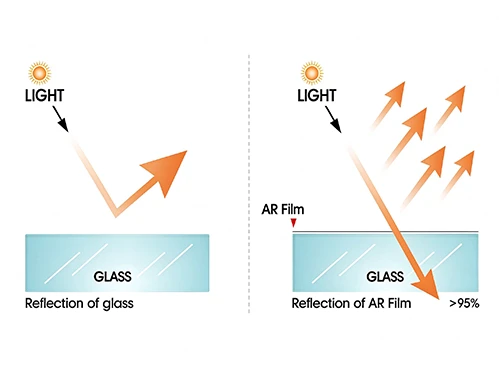
The most immediately obvious difference is how much light bounces off the surface. Regular clear glass reflects about 8% of incoming light - enough to create a visible mirror image under gallery lighting. Stand in front of a painting behind regular glass and you'll see the ceiling lights, your own reflection, and the room behind you superimposed on the artwork. It's distracting, and it makes the painting feel further away.
Non reflective museum glass cuts that reflection to under 1%, and in premium configurations to under 0.5%. At that level, the reflection is so faint that visitors don't notice it - they see the painting instead. The difference isn't subtle. Once you've seen a major painting behind museum glass, regular glass feels like looking through a smudged window. The colors are richer, the blacks are deeper, and the texture of the canvas or paper comes through clearly.
How the Reflection Is Reduced
Museum glass achieves low reflection through a multi-layer thin-film coating applied in a vacuum chamber. Each layer is a few nanometers thick, with a carefully chosen refractive index. Light reflecting off different layers cancels out through destructive interference, which is the same technology used in high-end camera lenses and telescope optics. The coating is bonded to the glass at the molecular level, so it doesn't peel, wear off or degrade over decades of display.
Related post: "What is the difference between anti-reflective glass and normal glass? Performance, Appearance and Use Case Comparison"
Glass Substrate and Color Neutrality
Regular float glass has a subtle green edge tint caused by iron impurities. On thin picture-frame glass it's barely noticeable, but on thicker panels - or when you look through the edge of a large frame - it gives everything a slightly greenish cast. For everyday windows that doesn't matter. For a gallery, it's unacceptable. A painting behind green-tinted glass doesn't look the way the artist intended. The blues shift, the reds dull, and the whites take on a greenish hue.
Museum glass uses low-iron glass substrates, which have had most of the iron removed during manufacturing. The result is a glass that's optically neutral - no green cast, no color shift, accurate rendition across the full visible spectrum. When curators compare paintings under controlled lighting, they need the glazing to be transparent in the truest sense of the word: not just letting light through, but not altering it. Low-iron substrates are how that's achieved.
Edge Quality and Finishing
Regular glass is typically cut and polished to basic standards, with raw or lightly seamed edges. Museum glass, particularly for large frameless installations and display cases, is produced with precision edge finishing - polished, mitered, or matte-edged to prevent light from piping around the frame. Light piping is when ambient light travels along the edge of the glass and creates unwanted internal reflections; it's a subtle optical problem that museum-grade finishing specifically addresses. For a professional gallery or museum, these details matter.
Safety and Structural Considerations
Regular picture frame glass is typically thin annealed glass - 2mm to 3mm - which breaks easily and creates sharp shards if it's damaged. In a home, that's a minor risk. In a public gallery with crowds, it's a safety and security issue. Museum glass is often fully tempered for strength, or laminated for added security. Tempered museum glass is four to five times stronger than annealed and shatters into small blunt fragments if broken. Laminated museum glass uses an interlayer that holds the pieces together even if the glass cracks, which is used for high-value exhibits and public installations where impact resistance matters.
For large paintings, oversized works, and museum display cases that need to meet building codes, tempered or laminated construction is often a requirement. A commercial glass manufacturers partner that specializes in art glazing can specify the right safety configuration for each installation.
Related post: "Is there a way to make glass non-reflective? Methods, Applications and Bronze Anti Sun Glass Guide"
A Side-by-Side Comparison
When you put regular glass and museum glass next to each other, the differences stack up quickly.
| Characteristic | Regular Glass | Non Reflective Museum Glass |
|---|---|---|
| Surface reflection | ~8% visible glare | Under 0.5%, nearly invisible |
| Light transmission | ~85-90% | 97-99% |
| UV blocking | Partial (~75% UVB) | Up to 99%+ (UVA and UVB) |
| Substrate | Standard float (green tint) | Low-iron (neutral color) |
| Safety | Thin annealed, sharp shards | Tempered or laminated available |
| Edge finishing | Basic seamed | Polished, matte or mitered |
| Best for | Everyday windows, cheap frames | Museums, galleries, fine art |
| Lifespan in display | Decades, but no UV protection | Decades, with conservation protection |
The pattern is clear. Regular glass is fine for windows and everyday framing. Museum glass is a complete glazing system engineered for one purpose: presenting artwork clearly and protecting it for the long term.
Luck Glass: Your Non Reflective Museum Glass and Art Glazing Partner
Luck Glass is a professional architectural and decorative glass manufacturer producing a full range of anti-reflective and art glazing products, including Non Reflective Museum Glass, Non Reflective Glass for Artwork, AR Reflection Free Glass, Anti Reflective Art Glass, AR coated tempered glass, non reflective tempered glass, anti-glare tempered glass, Bronze Anti Sun Glass, dichroic glass, laminated glass, reeded glass, frosted glass, back painted glass and more. The company supplies global anti reflective glass company networks, commercial glass manufacturers, glass supply company partners, building material traders and brand clients, with advanced vacuum coating, tempering, laminating and finishing production lines.
Luck Glass produces Non Reflective Museum Glass on low-iron substrates with multi-layer anti-reflective coatings, delivering residual reflection as low as 0.3% per surface, light transmission up to 99%, and integrated UV blocking up to 99%+ across UVA and UVB ranges. All museum glass can be tempered for safety, laminated for added security, or produced with both-side coating for large-panel installations. Edge finishing options include polished, matte and mitered edges. Full customization is supported across thickness (2mm-12mm), panel size, coating configuration, edge treatment and cutouts, with maximum panel sizes up to 3660mm x 2440mm.
Whether the project calls for Non Reflective Museum Glass for a gallery exhibition, Non Reflective Glass for Artwork for a private collection, anti-reflective display case glass for a museum renovation, or bulk supply from a glass supply company for a large-scale cultural institution, Luck Glass delivers consistent optical and conservation performance, technical support on UV protection and framing requirements, and reliable lead times for both sample orders and full-container shipments.
Related post: "What is AR coated tempered glass? Anti-Reflective Coating, Safety Strength and Applications"
Frequently Asked Questions
Q: What is the difference between museum glass and regular glass?
A: Museum glass is a high-performance glazing designed specifically for artwork. It has ultra-low reflection (under 0.5% compared to 8% for regular glass), up to 99% UV blocking to prevent fading, low-iron glass for neutral color accuracy, and tempered or laminated construction for safety. Regular glass is clear and transparent but reflects visible glare, offers minimal UV protection, and has a slight green tint.
Q: Is museum glass worth it for artwork?
A: Yes, for any artwork you care about. The low reflection lets viewers see the piece clearly without glare, the UV blocking prevents fading over decades, and the color-neutral substrate ensures the artwork looks as the artist intended. For valuable paintings, works on paper, textiles and photographs, museum glass is the conservation standard.
Q: Can I use regular glass for picture framing?
A: You can, but it's not recommended for valuable or sensitive artwork. Regular glass offers partial UV protection and visible reflection. For everyday framing of prints or photographs that aren't high value, regular glass is acceptable. For fine art, collectibles and museum pieces, Non Reflective Museum Glass is the right choice.
Q: Does museum glass block all UV?
A: Museum-grade non reflective glass blocks up to 99% of ultraviolet radiation across both UVA and UVB ranges. No glazing blocks 100% of UV, but museum-grade filtering is sufficient to prevent the vast majority of light-induced fading in indoor display environments.
Q: Can museum glass be cut to size?
A: Yes. Non Reflective Museum Glass can be custom cut to specific dimensions, tempered for safety, laminated for security, and produced with various edge finishes. A reputable glass supply company can handle custom sizes, cutouts and edge work to match specific frame or display case requirements.
Final Thoughts
Museum glass and regular glass might look similar when they're leaning against a wall in a glazier's workshop. But once they're installed in front of a painting, the difference is immediate and impossible to miss. Regular glass does the basic job of protecting the artwork from dust and handling, but it reflects the room, lets UV through, and carries a subtle green tint. Museum glass does all of that - and then disappears. The reflection drops to nearly zero, the UV is blocked, the colors come through neutral, and the safety construction meets public-gallery standards. It's not a luxury upgrade for fancy frames. It's the material institutions rely on when the artwork is worth preserving for the next hundred years. For collectors, curators and galleries, that's not a difference you can see - it's a difference you can feel, the moment you look at a painting and realize there's no glass between you and it at all.
Related post: "Is there glass that doesn't reflect? Non Reflective Tempered Glass for Safety and Clarity"