Neither is better in the abstract, because they are two different kinds of glass built for different jobs. An anti glare glass sheet changes the surface so reflected light is scattered and a room feels calmer; a coated pane leaves the surface smooth and uses a thin film to cut reflection while keeping the view sharp. One trades a little clarity for comfort and cover, the other preserves clarity at a higher cost. Specifying them as synonyms is the fastest way to order the wrong product. The wider family of decorative glass sells both, so the first job is to tell them apart.
They are two different products, not two names for one
Why buyers mix them up
Both are sold as answers to reflection, and catalogue copy tends to use the same words for each. A listing may promise "less glare" for a coated panel and "reduced reflection" for a textured one, as though the two were interchangeable finishes on the same base. They are not. One is a surface treatment that changes how light leaves the glass; the other is a deposited film that changes how much light is reflected at all. The outcomes look similar in a showroom but diverge the moment the panel is installed under real lighting.
One scatters the light, the other cancels it
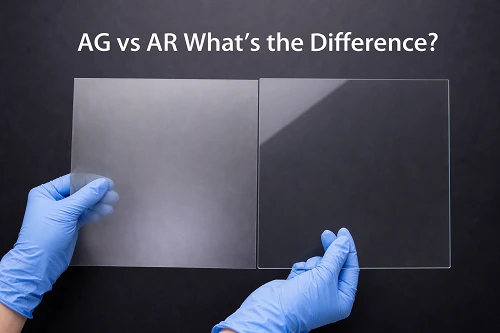
A non glare glass pane is roughened - lightly etched, sandblasted or textured - so incoming light is sent in many directions instead of bouncing back as a sharp image. The mirror effect softens into a wash, and some detail through the pane is lost as a direct result. That loss is the mechanism working, not a defect. A coated pane is not roughened at all. Extremely thin films are deposited under vacuum so that reflections from the layers cancel one another, leaving more light to pass through. The surface stays smooth and the view stays clear, with no haze.
The difference shows up in the job each one does
Scattering reduces the sharpness of a reflection; a coating reduces the amount of reflected light. Those are neighbouring problems, not the same one. A partition beside a monitor needs the first, because a dimmer but still crisp reflection would keep distracting the person at the desk. A vitrine needs the second, because any haze would blur the object the glazing is meant to display. Ask which outcome the project actually wants before comparing names or prices.
A third finish often enters the same comparison. ⇒ Related Post: Which is better, anti-glare or glossy? A Buyer's Comparison
Anti-glare glass: how it works and where it goes
The mechanism is in the surface
An anti glare glass sheet is produced by changing the surface of the glass itself. Light acid etching, sandblasting or a rolled texture creates a fine roughness that breaks up a direct reflection. Because the texture is in the surface rather than laid on top, it cannot peel away and it tolerates more handling than a deposited film. The trade-off is built in: the same scattering that softens the reflection also reduces clarity, so this is not a finish for a pane that must show fine detail.
What it actually gives you
The practical benefit is visual comfort. A non glare glass surface stops a lamp, a window or a screen from appearing as a second image in the glass, which matters where people work or walk for long hours. It also takes the edge off a view into a busy area. That obscuring effect is mild, though - it softens detail without hiding it, so this finish should not be sold as a privacy product. Where the view must actually disappear, a heavier frosted or textured glass pane is the correct specification.
How far a textured finish really obscures a view. ⇒ Related Post: How Private Is Textured Glass? Light, Doors And Panels
Where it is normally used
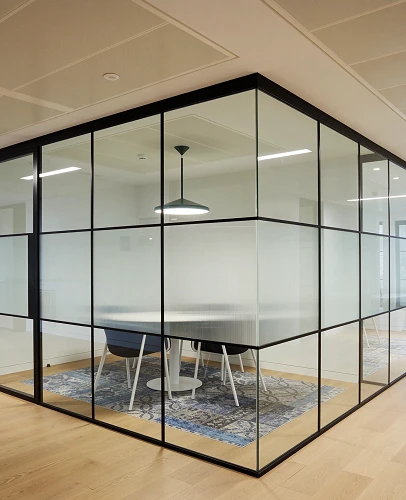
Typical installations are office partitions, meeting rooms, control rooms and any panel beside a screen or a bright light. Specifiers also use it on interior doors and corridor screens where daylight should stay but a hard reflection should not. A non glare glass finish is mature and applies to standard bases, which keeps it accessible for large fit-outs. Ask which face carries the texture and how it is marked before cutting, so the treated side is not laid face-down on a dusty bench.
The downsides are set out in full here. ⇒ Related Post: What are the disadvantages of anti-glare glass? Trade-Offs
Anti-reflective glass: how it works and where it goes
The mechanism is a thin film
An anti reflective glass surface is not roughened. A stack of extremely thin metal-oxide films is deposited under vacuum so that reflections from the layers interfere with one another and largely cancel. More light passes through, and the pane stays optically clear - there is no scattering and no haze. The effect depends on the film remaining intact, which is why the coated face has to be identified and protected through cutting, edging and handling.
What it actually gives you
The gain is transmission and an unclouded view. A non reflective glass sheet is chosen when seeing through the pane is the whole point: the object, artwork or display behind it reads exactly as intended, without a mirror image of the room laid over it. It does not conceal anything, and that is a feature rather than a shortcoming in a gallery or a shopfront. If the brief also calls for screening, add a separate element rather than expecting one pane to do both jobs.
Where it is normally used
Common settings are museum cases, gallery framing, high-end retail vitrines, precision display panels and museum-grade picture frames. The same build appears in shopfronts and reception screens where clarity sells the product; an anti glare glass sheet would blur the display in these settings. A non reflective glass panel with the coating on a protected inner face of a sealed or laminated unit will keep its performance far longer than an exposed coated face, and the patterned glass range shows how different a textured pane looks beside it. Confirm that face position and the order of coating and tempering for your exact panel.
What shortens a coating's life, and how to check a claim. ⇒ Related Post: How long do anti-reflective coatings last? Lifespan And Care

How to choose between them
Start with the outcome, not the name
Write down what the pane must achieve in one sentence. "Softened reflection, view still legible" points to a textured finish; "low reflection, maximum transmission" points to a coating. An anti glare glass sheet suits comfort-led interiors where a little haze is acceptable; a coated pane suits any setting where clarity is the product. Once the outcome is written, the catalogue name stops being the deciding factor, and two suppliers will quote against the same understanding.
Check the build and the face position
Both products can be combined with tempering or laminating, but the sequence differs. A texture is part of the glass and generally survives heat treatment well. A coating must either withstand the tempering heat or be applied afterwards, and the coated face needs protection at every later step. A non reflective glass sheet with the film sealed inside a unit is a different product from the same coating on an exposed face, and the price should reflect that.
Approve a sample under real light
Ask for a full-size sample of the exact build and view it under the lighting of the actual space. For a textured pane, check how much detail remains readable and whether the finish is even across the sheet. For a coated pane, check the coated face, the edges and the absence of haze. A non glare glass sample that looks right under a showroom spotlight can read too hazy under a bright office ceiling, so test in the intended conditions rather than accepting a small offcut.
If the coated pane must also meet a safety rating. ⇒ Related Post: Is there anti-reflective tempered glass? Coating And Buyer Checks
FAQ
Are these two actually different products?
Yes. One is a surface-textured pane that scatters light; the other is a smooth pane with a vacuum-deposited film that reduces reflection. They are not two grades of the same glass and cannot be substituted for one another. Name the mechanism in the specification so both sides quote the same product.
Which one lets more light through?
The coated pane does. Its film reduces the light bounced back at the surface, so transmission rises and the view stays sharp. An anti glare glass pane sends part of the light in different directions, which softens the reflection but also lowers clarity. Where daylight and a clear view are the priorities, the coated option is the right starting point.
Which finish gives privacy?
Neither should be relied on for real privacy. A non glare glass pane softens detail without hiding it, so shapes behind the glass remain readable. A non reflective glass sheet does not obscure at all. For a space where the view must disappear, specify a heavier frosted or textured finish, or add a separate screening layer. Treat mild obscuring as a side benefit, never as the specification.
Can either be tempered or laminated?
Yes, but the order matters. A texture is part of the glass and usually tolerates tempering well. A coating must either survive the heat of tempering or be applied afterwards, and the coated face needs protection through every later step. Confirm the full sequence for your exact panel before the order is placed, rather than assuming a standard process applies.
Which is easier to maintain?
The textured finish is more forgiving: it cannot peel, and gentle routine cleaning keeps it consistent. A deposited film needs a stricter routine - soft cloths, mild neutral detergent, no dry wiping over grit, no harsh solvents - or it can be marked and read as a failure. Put that routine in the handover documents for whoever maintains the glass later.
A Chinese Glass Supplier For Glazing Projects: Luck Glass
Luck Glass is a glass processing manufacturer focused on the deep-processing of decorative and obscure glass for both residential and commercial projects. Across our ranges we produce acid-etched, frosted, painted, fabric and textured glass, supplied as cut-to-size panels with the finish, color and safety treatment each project needs - tempered, laminated, or a combination of both. Our multiple deep-processing lines support consistent batches across large orders, and we work with distributors, contractors and brands in many countries worldwide. From a private bathroom partition to a multi-floor commercial fit-out, our fabrication is cut-to-size and matched to project drawings.
Looking beyond one factory at the wider supplier landscape. ⇒ Related Post: Top 10 Glass Manufacturers & Suppliers in China: An In-Depth B2B Guide
Summary
These are two different glass products with different jobs. A textured pane scatters reflected light for comfort and a softer view, while anti reflective glass uses a thin film to keep reflection low and the view clear. Choose the textured finish for screen-side comfort and mild concealment; choose the coated pane for galleries, vitrines and anywhere clarity and transmission are the point. Because they are built differently, they also differ in cost, durability and fabrication order. Write the outcome, the base, the face position and any safety treatment into the specification, and approve a full-size sample under the real lighting before the order is placed.