Fluted glass is a sheet formed with regular vertical ribs that scatter light and soften whatever sits behind it. It is translucent: light passes freely, but a clean view does not. For a specifier the useful model is simple - clear glass shows everything, fluted glass shows light and movement. Warm-toned Autumn Obscure Glass is one option within this family, while frosted fluted glass pairs the ribs with an etched ground. Buyers searching for fluted privacy glass are after the same result: a bright space that is no longer fully readable. Knowing what the ribs do - and what they cannot - is the start of specifying them well.
What Fluted Glass Is - And What It Is Not

The ribs are pressed while the glass is still hot. Molten glass passes between patterned rollers that leave repeating vertical channels across one face. Because the texture belongs to the glass rather than a coating, it cannot peel or rub off - an important point in high-touch locations such as doors and cabinet fronts.
Fluted glass is translucent, not transparent and not truly opaque. Light crossing the ribs bends in many directions, so a viewer receives brightness without a sharp image. Close to the pane you may make out movement; step back and the view becomes texture. That is exactly the behaviour to judge on a sample, because the same rib at two viewing distances performs differently.
Frosted fluted glass adds a second layer of diffusion: the ribs give direction while an acid-etched ground scatters light evenly across the sheet. The two mechanisms complement each other, covering more of the view than ribs alone. Our patterned glass is supplied cut-to-size for exactly this kind of project.
Patterns carry different names in different markets, and those names are worth pinning down early ⇒ Related Post: "What Do You Call Patterned Glass?"
Reeded, Ribbed And Frosted: Why The Names Overlap
A buyer soon notices that one panel is sold under several names. Fluted, reeded and ribbed glass are treated as interchangeable in most catalogues, and the visual difference between them is small. All three describe a surface built from repeated vertical ribs that scatter light in a directional way. Naming one is describing a family of appearance, not a single proprietary product.
Frosted is a different kind of word. It describes a finish rather than a rib geometry, which is why frosting can be applied to a fluted sheet as well as a flat one. A buyer asking for a frosted version is combining two ideas: the linear structure of the ribs and the even diffusion of an etched surface. Keeping those decisions separate makes a sample book easier to read and a specification easier to write.
A vague term leaves the choice to the seller. Naming the rib direction, finish and base glass together removes that ambiguity and gives a repeat order something concrete to match. Our textured glass range is grouped this way so a buyer can specify the finish and the geometry separately.
Some patterns collect several informal names along the way ⇒ Related Post: "What Is Another Name For Ribbed Glass?"
How The Flutes Actually Create Privacy
The ribs behave like a field of tiny lenses. Light arriving from one side is refracted and reflected along the curves, then diffused across a range of angles rather than passed straight through. The eye still reads brightness on the far side, but the information needed to assemble a sharp image is broken up. That is both the appeal and limit of the product.
The limit is worth stating plainly. Fluted privacy glass softens a view; it does not erase it. At close range a dark silhouette or strong colour still reads, and a lit figure against a darker room is more visible than the reverse. Buyers needing a guaranteed barrier at a defined distance should judge a sample held there, under lighting close to the installed condition.
Direction is the second consideration. Because the ribs run vertically, the glass obscures most effectively across them and least along them. Orientation should be stated on the drawing, not left to the installer. Frosted fluted glass reduces this directional weakness by adding even diffusion, which is why it is chosen where the viewing angle cannot be controlled.
Privacy is the question behind most of these checks ⇒ Related Post: "How Private Is Textured Glass? Light, Doors And Panels"
Warm Tones And Tinted Options

Most fluted glass starts as clear or low-iron glass, and for many projects that neutrality is what is wanted. There is also a family of body-tinted versions in which colour enters the melt, producing amber, bronze or smoke tones. A warmer pane absorbs part of the light passing through, deepening the diffusion and giving a softer, more atmospheric quality.
Autumn Obscure Glass sits in this warm-toned group. It is the specification a designer reaches for when a neutral grey feels too clinical and the interior calls for an amber cast. Because the tint is in the body rather than on the surface, it does not scratch away and stays consistent within a batch. Autumn Obscure Glass is often paired with frosted fluted glass where a warm tone and an even, soft view are both required.
For a distributor or contractor the value of a named warm option is repeatability. A project calling for Autumn Obscure Glass across several floors needs the same tone in every panel, which is easier when the tint belongs to a standing range rather than a one-off match. Keep a signed sample for both tone and rib detail, and order one area's panels together.
Colour is a specification decision with consequences for light, privacy and batch matching, and it belongs written down beside the pattern name.
The range behind a pattern name is worth checking before it is specified ⇒ Related Post: "What Are The Different Types Of Decorative Glass?"
What Drives The Cost Of Thicker Panels
Buyers often arrive with a thickness in mind and ask for a 10mm fluted glass price as if thickness alone decided the answer. It does not. The number that matters is the delivered cost of a finished pane that meets the drawing, built from several separate decisions.
Thickness is one driver, but so are sheet size, the number of cut pieces, edge work, drilling, and whether the panel needs tempering or laminating. A thicker sheet handles differently on the line, and any safety treatment must be scheduled after all cutting and drilling. Each step adds an operation that has to appear in the quote.
The pattern is another factor. A rib geometry already in regular production is cut from stock sheets; one needing a dedicated run-up is a different proposition. This is why two suppliers quoting a 10mm fluted glass price can land far apart - one may be quoting from an established range, the other from a special run. Asking which patterns are in continuous production is more useful than asking for a number in isolation.
Freight and packing belong in the same conversation: textured panels are heavy and can be damaged at the edges, so crate and handling methods affect the final figure.
A supplier's production setup shapes what can actually be delivered ⇒ Related Post: "Where Can I Buy Float Glass? A B2B Buyer's Guide"
Where Specifiers Use These Panels
The applications follow from the behaviour above: bright, softened separation without a solid wall. Interior partitions and meeting-room glazing are the most common commercial use, because fluted privacy glass keeps a room visually connected to the floor around it while removing the distraction of a clear sightline. On a fit-out with repeated panels, rib orientation and batch consistency matter as much as the motif.
Cabinet fronts and wardrobe inserts are a second natural home. The glass is close to the viewer and handled daily, which favours a durable surface - the ribs are in the glass, not printed on it. Frosted panels hide a cupboard's contents while still letting light reach the interior.
Bathroom windows, wet-room screens and internal doors form the third group. These are where the privacy question is sharpest and where cleaning and safety treatment need attention. Warm options such as Autumn Obscure Glass appear more often in hospitality and retail, where the tone is part of the design language and must be matched across a fit-out. Supplied cut-to-size through our frosted glass range, textured panels become a project component rather than an afterthought.
Glazed entrances and internal screens have changed a great deal in recent seasons ⇒ Related Post: "What Is The New Trend For Front Doors?"
Checks Before You Place The Order
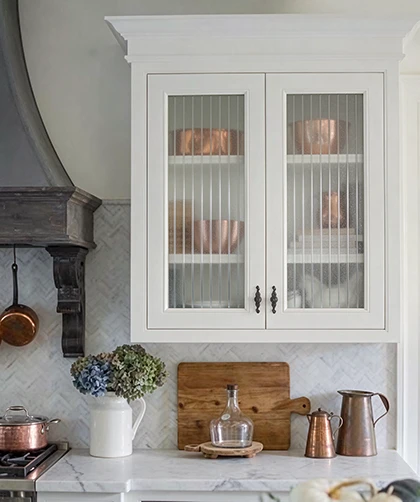
A short checklist prevents most installation problems. First the sample: hold it at the real viewing distance, against both a bright and a dark background, because fluted glass changes character with lighting. Approve tone and rib detail together - a warm option should be judged as a complete appearance, not a colour chip.
Second the processing sequence. Cutting, edging and drilling all happen before tempering, and a supplier who cannot state that order in writing is not ready to quote a complex panel. Ask which treatments are available on the chosen pattern and how they affect lead time.
Third the quote. A 10mm fluted glass price means little unless it states the sheet size, quantity, finish, edge work and safety treatment it covers. Comparing two numbers describing different scopes is a false economy; request the same specification from each supplier and the difference becomes meaningful.
Finally, keep a reference sample. Variations in tint and rib detail are easier to control when everyone works to the same approved piece.
Defining the category first makes every later decision easier ⇒ Related Post: "What Is An Obscure Glass? Definition, Types And How To Source It"
FAQ
Is fluted glass the same as reeded glass?
In practice, yes - most suppliers use both names for the same ribbed, light-scattering glass. A technical distinction is sometimes drawn between concave grooves (fluted) and convex ridges (reeded), but the visual result is close. Specify rib direction, finish and base colour rather than relying on the name alone.
Does frosted fluted glass block the view completely?
No. It diffuses light more evenly than a clear ribbed pane, so the view is softer and less readable, but a close silhouette can still show. It suits spaces needing partial privacy with daylight. Where a full visual barrier is required, an opaque interlayer or backing is the correct specification.
Can fluted glass be tempered or laminated?
Yes, on most established ranges. Tempering and laminating must follow all cutting, drilling and edging. For doors, partitions and low-level panels, ask the supplier to state the safety treatment on the quotation rather than assume it.
Why does a quote for a thicker pane vary so much?
Thickness is only one input. Sheet size, quantity, edge work, drilling, tempering, lamination, whether the pattern is in regular production, and freight all change the total. A 10mm fluted glass price should be read together with the specification it covers.
Is a warm tint suitable for a large project?
Yes, provided it comes from a standing range. Body-tinted options keep their colour through cutting and finishing, but tone can shift between production runs. Approve one sample and keep a single area's panels in the same batch wherever possible.
Your Partner For Decorative Glass: Luck Glass
Luck Glass is a glass processing manufacturer focused on the deep-processing of decorative and obscure glass for both residential and commercial projects. Across our ranges we produce acid-etched, frosted, painted, fabric and textured glass - including fluted and ribbed patterns - supplied as cut-to-size panels with the finish, color and safety treatment each project needs, tempered, laminated, or a combination of both. Our multiple deep-processing lines support consistent batches across large orders, and we work with distributors, contractors and brands in many countries worldwide. From a single bathroom partition to a multi-floor commercial fit-out, our fabrication is cut-to-size and matched to project drawings.
Summary
Fluted glass is a translucent, ribbed sheet that scatters light and softens the view without blocking daylight. Fluted, reeded and ribbed names overlap, while frosted describes an added finish rather than a different geometry. Partial privacy must be judged at the real viewing distance, and rib direction and batch consistency matter on repeated panels. Warm options such as Autumn Obscure Glass bring tone and batch matching into the specification, while thickness only becomes meaningful once size, finish, processing and quantity are fixed. Name the pattern, finish, tint and safety treatment together and approve a physical sample for a result that repeats from the first panel to the last.