Float glass is bought in bulk from a processor, an importer or a distributor, and the choice depends on how much of the processing you intend to do yourself. A fabricator who cuts and tempers in-house wants jumbo sheets and a stable base grade. A contractor who needs finished panels wants a supplier who will deliver them cut, edged and treated, to the drawing.
Both are buying the same material. What differs is where the value is added, and that is what decides the price per square metre, the tolerance you can hold, and who carries the risk when a panel arrives wrong.
What Buyers Actually Order
Four Stages Of The Same Material
In trade terms, float glass moves through four stages:
Jumbo sheet - the raw ribbon cut to a stock size, sold by the pack or the A-frame.
Cut size - a rectangular piece cut to a dimension, edges unworked.
Processed part - cut, edged, drilled, and tempered or laminated.
Finished unit - a processed part assembled into a frame, a sealed unit or a system.
A quote for "float glass" means nothing until you know which stage is being priced: the material cost is the same in all four, and the difference is labour, yield loss, treatment and handling.
Why The Stage Decides The Supplier
Each stage has a natural supplier: jumbo sheets from float lines and their distributors, cut sizes from processors or distributors with a cutting table, processed parts from a fabricator with tempering and laminating, finished units from a systems supplier.
Buying upstream of where you need it is usually a false economy - you save the margin but take on the waste, handling and quality risk.
The vocabulary around flat glass is a common source of mismatched quotes ⇒ Related Post: "What Do You Call Patterned Glass?"
The Supply Chain Behind It
Float Lines And The Jumbo Sheet
Float glass is made by pouring molten glass onto a bath of molten tin, where it spreads under gravity into a continuous ribbon. Because nothing solid touches the upper surface while it is soft, both faces come out fire-polished and parallel, with a thickness set by the draw speed.
The ribbon is cut into jumbo sheets at the cold end - the unit of trade for everything downstream. The same sheet becomes a shower panel, a door light, a sealed unit or a decorative pane.
Processors, Importers And Distributors
A processor buys jumbo sheets and sells geometry: cutting, edging, drilling, tempering, laminating and patterning. An importer brings container loads of standard stock into a region and sells by the pack. A distributor holds local inventory and sells cut sizes or full sheets at short notice.
In practice the three overlap: many processors import their own base glass, many distributors run a cutting table. What separates them is capability, not category - the question is which stages they deliver in-house.
What Each One Is Good At
Processor - tolerance, treatment, one point of responsibility, and nesting across a sheet.
Importer - price on standard thicknesses and tints at container scale, limited processing.
Distributor - availability and speed on standard sizes, at a margin.
Quality differences show up most clearly once the glass is in an insulated unit ⇒ Related Post: "How can you tell if double glazing is good quality?"
Cut To Size: What To Put In The Enquiry
Dimensions, Tolerance And Nesting
When you order float glass cut to size, the enquiry needs four numbers per part: width, height, thickness and quantity - plus the tolerance class. Nominal and exact are different instructions: the gap matters when a panel sits in a rebate.
Nesting is where yield is won or lost. A processor who fits your parts onto a standard sheet with little waste can quote lower than one who cuts each part from a fresh sheet. For a mixed set, send the full list: the arrangement across a sheet is a large part of the cost.
Edge Work Decided By The Fixing
The edge specification follows how the panel is held:
Arrised - a light grind to remove the sharp arris; the minimum for handling and glazing into a frame.
Ground - flat and matte, where the edge is visible but not prominent.
Polished - clear and glossy, for exposed work.
Bevelled - a decorative chamfer, usually on mirrors and feature panels.
State the edge on the drawing: a cut edge straight off the table is sharp and weak, and cannot be corrected after tempering.
Once the glass is patterned, the profile choice matters as much as the base ⇒ Related Post: "What Is Another Name For Ribbed Glass?"
Panels: Packing, Handling And Breakage
How Panels Travel
A float glass panel travels in an A-frame, an end-cap or a crate, depending on size and route. The packing method is part of the specification, not an afterthought: thin sheets in a poorly braced crate flex in transit, and flexing is what breaks glass.
For export, ask how the crate is braced, whether panels are interleaved, and whether the A-frame is timber or steel. Those answers predict breakage more reliably than any promise about careful handling.
What To Inspect On Arrival
Check before signing: edge chips, corner damage, surface scratches, and any distortion visible at a low angle to the light. Edge chips are the most common defect and the most likely to propagate once installed.
Whether the order is plain float or a textured glass range, confirm the label matches the drawing - thickness, dimensions and treatment. A tempered panel that arrives at the wrong size cannot be cut down, and the loss is total.
Patterned glass behaves differently in wet areas, and this covers the practical side ⇒ Related Post: "What is rain pattern glass? Rain Pattern Shower Glass And Uses"
Choosing A Supplier
The Five Questions That Sort Them
Ask any float glass supplier five things before a first order:
What thickness range do you hold as stock, and which do you have to bring in?
Which processes are in-house and which are subcontracted?
What tolerance can you hold on a cut size, and how is it measured?
How is the base glass graded, and can you supply the same grade on repeat orders?
How do you pack for export, and who carries breakage in transit?
The answers separate a trader from a manufacturer: one answers from a price list, the other with a number.
Batch Consistency And Base Grade
For a fabricator choosing a float glass supplier, the hidden cost is batch variation. Standard clear carries a faint green edge tint that shifts between suppliers and between runs. On a large project with panels from two batches, that shift shows at the joint.
Low-iron, sold as ultra-clear, removes most of the tint at a higher cost. Decide before the tender, not after the first delivery. Quality grade works the same way: bubbles, seeds and roller marks are graded, and a low price is usually a lower grade.
The naming trap that catches buyers on decorative ranges is worth knowing too ⇒ Related Post: "Why is it called glue chip glass? Diamond Pattern Glass Explained"
From Float Sheet To Florentine Pattern Glass
Where The Pattern Enters The Process
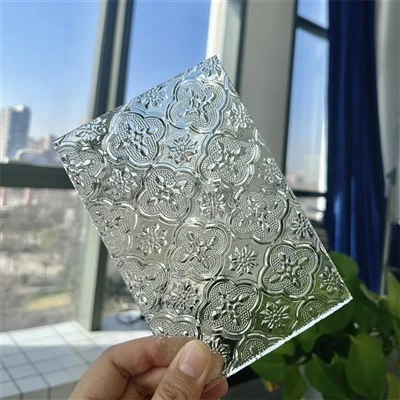
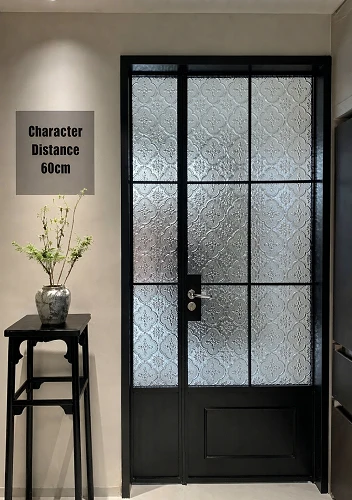
Decorative ranges are a downstream step, not a different material. Florentine pattern glass begins as a float sheet, is reheated, and passes between rollers - one carrying the engraved Florentine figure. The pattern is pressed in while the glass is soft.
The same applies across the catalogue: Diamond, Karatachi, Nashiji, Mistlite, Florentine. Each is float glass that has become a patterned glass with a textured face, and each carries the base grade of the sheet it started from.
Why Base Grade Shows Through
A pattern does not hide the sheet underneath it, any more than a frosted glass finish does. A standard clear base shows a green edge tint on thick pieces and against pale frames; bubbles or seeds sit under the pattern and appear when light passes through.
That is why a quote for Florentine pattern glass can come in well below the others without anyone lying: the difference is in the base sheet, not the roller.
This is the same naming trap that runs across the decorative range ⇒ Related Post: "What Is Glass Texture? Types, Uses And Decorative Panels"

Common Buying Mistakes
Pricing "float glass" without naming the stage. Raw sheet and processed part are different products.
Sending parts one at a time. Nesting across a full sheet is where the cost is decided.
Leaving the edge unstated. A cut edge is not a finished edge, and it cannot be corrected after tempering.
Switching base grade mid-project. A different tint between batches shows at every joint.
Ordering tempered glass before the opening is confirmed. It cannot be cut afterwards.
Textured and obscure ranges follow the same procurement logic ⇒ Related Post: "What Does Textured Glass Look Like? Privacy & Door Panels"
About Luck Glass
Luck Glass is a glass processing manufacturer focused on the deep-processing of decorative and obscure glass for both residential and commercial projects. Across our ranges we produce acid-etched, frosted, painted, fabric, textured and patterned glass, supplied as cut-to-size panels with the finish, color and safety treatment each project needs - tempered, laminated, or a combination of both. Our multiple deep-processing lines support consistent batches across large orders, and we work with distributors, contractors and brands in many countries worldwide. From a single shower screen to a multi-floor commercial fit-out, our fabrication is cut-to-size and matched to project drawings.
FAQ
Where can I buy float glass in bulk?
From a float line's authorised distributor, an importer, or a processor who buys jumbo sheets and resells cut sizes. For volume with processing, a processor is usually the single contact; for container-scale stock, an importer.
What is the difference between float glass and patterned glass?
Float glass is the base material, made on a tin bath. Patterned glass is float glass that has been reheated and passed through an engraved roller, so the pattern is pressed into one face. Every patterned product starts as a float sheet.
Can float glass be cut and tempered to order?
Yes, and both happen before tempering. The processor cuts from a jumbo sheet, edges and drills, then tempers. Once tempered, the glass cannot be cut or drilled, so every dimension and hole must be confirmed on the drawing first.
How do I check the quality of a float glass batch?
Inspect the edge for tint consistency, hold the panel at a low angle for distortion and roller marks, and check for bubbles and seeds against a bright background. Compare the batch with the approved sample, not only the specification sheet.
Is Florentine pattern glass made from float glass?
Yes. A float sheet is reheated and passed between rollers, one carrying the engraved Florentine figure. The base grade - clear, ultra-clear or tinted - determines the edge tint and clarity of the finished panel.
Summary
Float glass is bought in bulk from a processor, an importer or a distributor, and the right choice depends on which of four stages you need: jumbo sheet, cut size, processed part or finished unit. The material is the same at every stage, so the word describes a process rather than a specification. What moves cost and risk is the base grade, the nesting across a sheet, the edge work and the packing. Decorative ranges such as Florentine pattern glass sit downstream of all of it: the pattern is rolled into a float sheet, and the grade of that sheet still shows through.