Run your finger down a pane of glass with parallel vertical ridges and you will reach for the words "ribbed glass." The short answer to "what is another name for ribbed glass?" is reeded glass. The two names describe the same thing: a sheet of glass whose surface carries regular vertical ribs, rolled in during manufacture. Those ribs scatter light and blur what sits behind the pane, which is why ribbed glass shows up wherever privacy and daylight need to share a wall - bathroom windows, cabinet doors, and modern front doors.
Trade catalogs also list it as fluted glass (when the ribs are deeper and rounder), lined glass, or prismatic glass, and it sits comfortably inside the wider family of textured and patterned glass. This guide covers the names, the panel forms you can buy - including ribbed glass door panels and frosted ribbed glass panels - and what moves the ribbed glass price.
The Most Common Other Name: Reeded Glass
Ribbed glass and reeded glass are the same product with two names. "Reeded" borrows from the look of bundled reeds or canes - a row of slim vertical lines. In architecture and glazing specs you will more often see "reeded" than "ribbed," but both mean a pane with cast vertical ridges. If a quotation says reeded glass, it is the ribbed glass you pictured.
Why "reeded" beats "ribbed" in specs
Specifiers reach for "reeded" because it is the established trade term and it cleanly separates the vertical-rib look from other textures. "Ribbed" is the plain-language description homeowners use. For ordering and fabrication, reeded is the word that travels cleanly across suppliers.
Fluted glass - the deeper cousin
Fluted glass is reeded glass with deeper, rounder, column-like grooves. The ribs read as bolder and more classical. The line between reeded and fluted is a matter of rib depth and profile, not a different material, so the two are often grouped under the same ribbed-glass heading.
Lined, prismatic and rain glass
Lined glass simply emphasizes the parallel lines. Prismatic glass is ribbed glass engineered with angled ribs to bend and spread light - a historic choice for front doors and transoms. Rain glass is a wavy, non-linear cousin sometimes confused with ribbed. All share the goal of privacy through surface relief.
To tell the specific ribbed patterns apart before you spec them, this is the detailed comparison ⇒ Related Post: "What Is The Difference Between Fluted And Reeded Glass?"
How Ribbed Glass Is Made
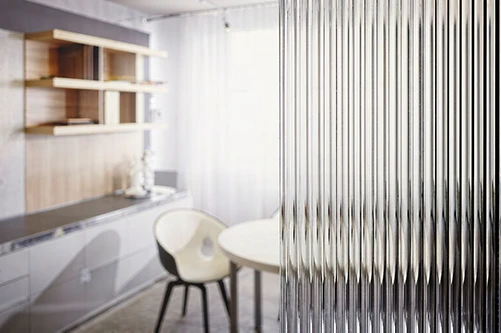
The ribs are not glued on. A curtain of molten glass passes between rollers, one engraved with the rib profile, so the ridges are pressed into the soft glass and set as it cools. That makes the pattern integral and consistent across large sheets, which is what lets a ribbed glass panel be cut to the exact size a project needs.
To go deeper on surface relief and the patterns behind it, this explains the bigger picture ⇒ Related Post: "What Is Glass Texture? Types, Uses And Decorative Panels"
Ribbed Glass Panel - The Core Product
A ribbed glass panel is the base unit you buy and install: a flat pane with the vertical-rib surface, supplied cut to size and finished for its job. The transparent base keeps rooms bright while the ribs hide detail. Panels come in clear and tinted bases, and the rib spacing can be fine (closely packed, softer blur) or wider (bolder lines, stronger obscuration). For most homes a ribbed glass panel lands as a window, a cabinet front, or a partition insert.
Ribbed Glass Door Panels
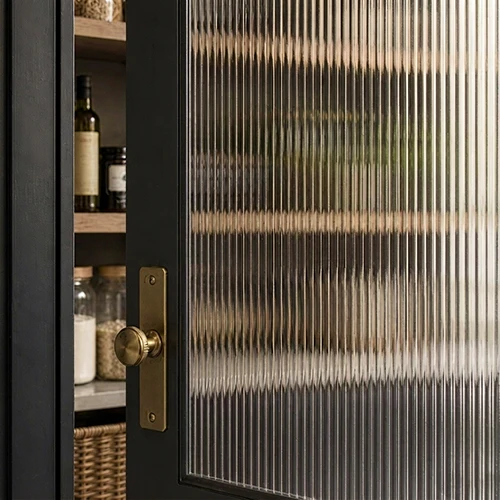
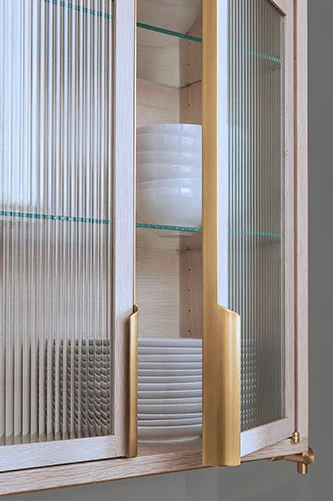
Doors are where ribbed glass earns its keep. A ribbed glass door panel lets light move between rooms or from a hallway into a private space without opening the view.
Where ribbed door panels work
Interior door lights, double-front-door inserts, and shower enclosures all use ribbed door panels. They give a bathroom or bedroom doorway privacy while still reading as bright and open. On a double entry door the two leaves can each carry a tall ribbed glass panel for a symmetrical, architectural look.
Privacy and light at the door
Because the ribs run vertically, they blur side-to-side detail - a person, a silhouette - while still passing plenty of daylight. That balance is why ribbed glass door panels suit both front doors and internal partitions.
For a direct look at how ribbed inserts fit the current door moment, this tracks the trend ⇒ Related Post: "What Is The New Trend For Front Doors?"
Frosted Ribbed Glass Panels
Frosted ribbed glass panels combine two privacy treatments: the cast vertical ribs plus a soft, etched haze. The result reads as both textured and cloudy, obscuring more than a clear-rib panel alone.
Acid-etched vs cast ribbed
A cast ribbed panel gets its relief from the roller. An acid-etched (frosted) ribbed panel adds a smooth, non-reflective bite to the surface - sometimes across the whole pane, sometimes just the rib faces. The frost deepens privacy without killing the light.
When to choose frosted ribbed
Pick frosted ribbed glass where the panel faces a bathroom, a street-level window, or any spot that needs maximum obscuration but still wants the ribbed look. It is the usual answer when a clear rib is not private enough.
For a direct read on how much you can actually see through these panels, this is the comparison ⇒ Related Post: "How Private Is Textured Glass? Light, Doors And Panels"
Ribbed Glass Products In Our Range
All of the panels below are ribbed glass - vertical-rib textured glass supplied as cut-to-size panels, with color, base transparency, and safety treatment specified per project. Here are five ribbed variants from the range.
Decorative Glass Texture
The transparent base carries fine, closely spaced clear vertical ribs with a faint green edge where light passes through. It is the quietest, most versatile ribbed panel - bright, subtle, and at home in cabinets, showers, and doors.
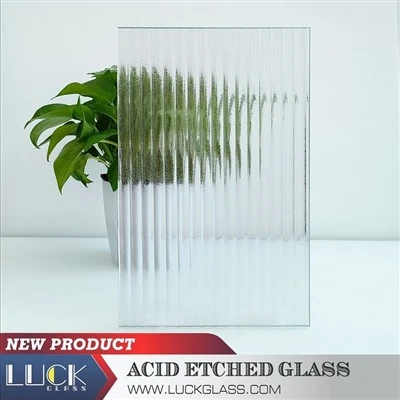

Reeded Textured Glass
A clear base with gray-to-silver-toned fine, dense vertical ribs. The cooler tone reads more contemporary and pairs well with blackened hardware and minimalist interiors.
Reeded Glass Texture
Very pale, slightly warm neutral ribs on a clear base. The soft tone suits restful spaces - a bedroom partition or a spa-like bathroom - where you want texture without a strong color statement.
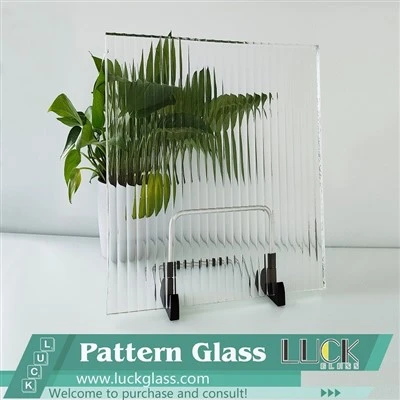
Reeded Glass Texture Seamless
Dark gray-to-black fine, closely spaced vertical ribs on a transparent base. The high-contrast ribs make a bold, graphic statement and read as a feature rather than a background.
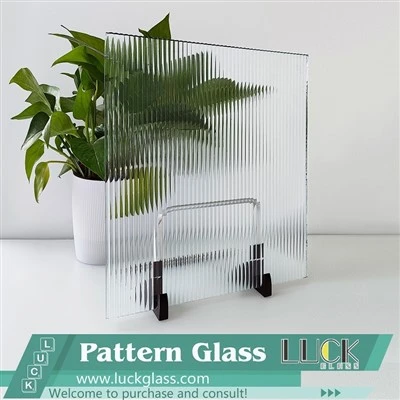

Aquatex Obscure Glass
A fine ribbed panel finished with an acid-etched frost, giving both relief and a soft haze. It is the most private of the five and the right pick when a clear rib does not obscure enough.
To see how these sit inside the wider named family, start here ⇒ Related Post: "What Do You Call Patterned Glass?"
What Affects Ribbed Glass Price
"ribbed glass price" moves with the same variables as other patterned glass, not a single fixed number. Understanding them helps you compare quotes without surprises.
|
Factor |
What it changes |
|
Rib depth and profile |
Deeper or custom ribs need more tooling than standard fine ribs. |
|
Glass thickness |
Thicker panes use more material and need sturdier handling. |
|
Safety treatment |
Tempering or lamination adds process steps and value. |
|
Tint and base |
Colored or low-iron transparent bases shift the cost versus standard clear. |
|
Order volume |
Larger, repeated batches are typically more efficient per panel. |
The practical takeaway: compare quotations by specification, not by a headline price. A clear thin rib and a laminated tinted frost are different products, so their prices should differ.
To see where ribbed glass fits among all the decorative types, this is the overview ⇒ Related Post: "What Are The Different Types Of Decorative Glass?"
Ribbed Glass Vs Other Textured Glassscription
Ribbed glass is one texture among many. Reeded and fluted give vertical lines; pebble and rock give organic bumps; frost and acid-etch give a smooth cloud; fabric-look gives woven depth. Choose ribbed when you want clean, directional lines and a bright, architectural privacy - pick a heavier pattern when obscuration matters more than the linear look.
To see why this ribbed look is back on specifiers' lists, the trend is tracked here ⇒ Related Post: "Is Reeded Glass Back In Fashion?"
Care And Cleaning Of Ribbed Glass
Ribbed glass cleans like any textured glass: a soft, non-abrasive cloth and a mild solution, with no harsh pads that could scuff the ribs. In a shower, a quick squeegee after use keeps the low spots free of mineral marks. A clean ribbed panel reads brighter because the ribs diffuse light.
About Luck Glass
Luck Glass is a glass processing manufacturer focused on the deep-processing of decorative and obscure glass for both residential and commercial projects. Across our ranges we produce acid-etched, frosted, painted, fabric and textured glass, supplied as cut-to-size panels with the finish, color and safety treatment each project needs - tempered, laminated, or a combination of both. Our multiple deep-processing lines support consistent batches across large orders, and we work with distributors, contractors and brands in many countries worldwide. From a private bathroom partition to a multi-floor commercial fit-out, our fabrication is cut-to-size and matched to project drawings.
FAQ
Is ribbed glass the same as reeded glass?
Yes. "ribbed glass" and "reeded glass" name the same vertical-rib textured glass; reeded is the standard trade term, ribbed the everyday description. Both describe a pane with cast vertical ridges that scatter light for privacy. You may also see fluted used for deeper ribs, but the product is the same - specify reeded on a quote to avoid confusion with other textures.
Can ribbed glass be tempered?
Yes. Most ribbed glass panels can be tempered after cutting, which raises strength for doors, showers, and partitions. Lamination is also available when sound control or post-break retention is needed. Tempering is done before edgework, and very deep ribs may need a quick check.
Is ribbed glass good for privacy?
It is. The vertical ribs blur side-to-side detail while still passing daylight, so a ribbed glass panel or door gives privacy without a dark, solid wall. For higher obscuration, choose a frosted (acid-etched) ribbed panel, which adds a soft haze on top of the relief.
Why is ribbed glass more expensive than clear glass?
Generally it costs more because the rib pattern adds a manufacturing step and often a specific base or finish. The final ribbed glass price depends on rib depth, thickness, safety treatment, tint, and order volume rather than a single figure, so compare quotes by full specification.
Summary
Ribbed glass is most often called reeded glass, with fluted, lined, and prismatic as related names for the same vertical-rib textured glass. It ships as a cut-to-size ribbed glass panel, works especially well as ribbed glass door panels, and reaches its most private form as frosted ribbed glass panels. Pick the rib profile, base tint, and safety treatment for the room, and compare ribbed glass price by full specification rather than a headline number.
Discuss your project requirements with our team