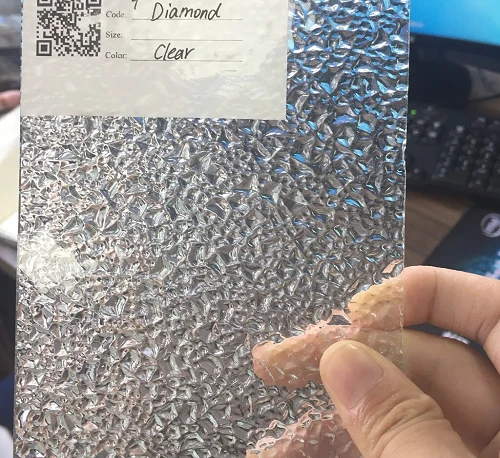
Glue chip glass is called that because glue made it. In the original process, animal glue was spread over a heated glass surface; as the glue dried it contracted, gripped the skin of the glass and tore it away in flakes, leaving a network of shallow shell-shaped fractures behind. The name records the method - glue, and the chips it pulled off - rather than any designer's intention.
That history explains a confusion buyers meet constantly. The same sheet is sold as glue chip, as diamond pattern glass, and as diamond glass pattern, because the trade never agreed whether to name the process or the look. Both names point at one material with a crystalline, light-scattering surface.
The Process Behind The Name
Glue, Shrinkage And Fracture
The technique belongs to the late nineteenth century, when glassmakers wanted a surface that broke up light more finely than rolling could. Hide glue was brushed onto a warmed sheet and left to set. Animal glue shrinks hard as it dries, and because it bonds to the glass more strongly than the glass bonds to itself, the contraction pulls away a thin surface layer.
What remains is a field of conchoidal fractures - the shell-like break you see on struck flint. Each is a tiny facet at a slightly different angle, which is why the sheet glitters instead of merely blurring.
Why "Chip" Is Literal
The flakes that came off were the chips. In workshop language the glass was "chipped" by the glue, and the name stuck. Nothing is chipped by hand; the removal happens in one pass, during the process.
The vocabulary around this family is messier than it looks, and this piece maps it out ⇒ Related Post: "What Do You Call Patterned Glass?"
Is It Still Made That Way?
The Rolled Imitation
Most glue chip sold today is rolled: a steel roller engraved with a random fracture pattern presses into the glass while it is still soft, producing a surface that reads the same from a metre away. It is cheaper, more consistent and available in large batches - and still called glue chip, because buyers ask for the pattern, not the method.
This matters when comparing quotes: two suppliers can both offer "glue chip" and deliver different surfaces - a genuine glue-crazed sheet with irregular facets, or a rolled reproduction whose pattern repeats across a large panel.
Telling Them Apart
On a rolled imitation the pattern repeats: look along a two-metre run and the same cluster of facets recurs at a fixed interval. A true glue-process sheet has no repeat, because the fracture follows the glue, not a drawing. For most architectural work the difference is invisible in place; for restoration or close-viewed feature panels it matters.
Visual behaviour across these surfaces is compared in more detail here ⇒ Related Post: "What Does Textured Glass Look Like? Privacy & Door Panels"
What The Surface Looks Like
A Crushed-Ice Field
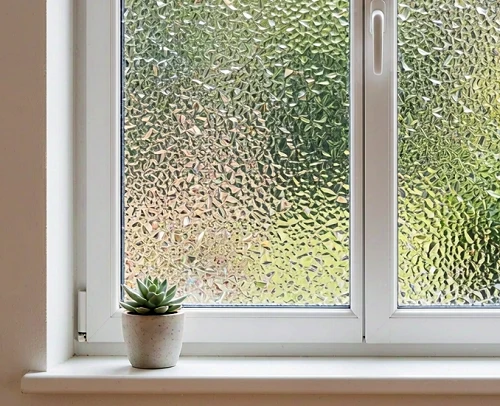
Glue chip reads as crushed ice: thousands of small angular facets, each catching a different part of the room, so the panel shifts between bright and dark as you walk past. There is no direction to it - unlike reeded or fluted glass, it does not smear the view into stripes but fragments it.
That randomness is the point. The eye cannot lock onto a repeating element, so the surface stays visually quiet even on a large screen.
How Much It Hides
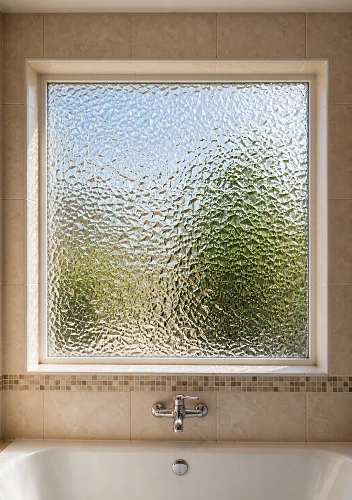
Obscuration is high. A glue chip panel at normal viewing distance shows no recognisable detail behind it - no faces, no text, no shapes beyond a general sense of light and colour. What it does not do is darken the room: transmission stays high because the facets redirect light rather than absorb it.
The trade-off is glare: in strong direct sun the panel throws a scattered sparkle across the floor, which some clients love and others ask to avoid.
The privacy-versus-light question comes up on every specification ⇒ Related Post: "Is Textured Glass See Through? Privacy & Light Explained"
Glue Chip And Diamond: One Product, Two Names
Where The Two Names Came From
"Glue chip" describes the process. "Diamond" describes what the surface looks like to a catalogue writer - a field of angular facets that reads as diamond-cut, which is why diamond glass pattern circulates as a term in its own right. Neither is wrong, and neither is a separate product. A factory may list the same roller under both headings because buyers search with different words.
The practical consequence is that a specification written as "diamond pattern glass" and a quote written as "glue chip obscure glass" can describe the same sheet. Confirm by sample, not by name.
Which Name To Put On The Paperwork
Pick one and keep it consistent through the drawing, the purchase order and the delivery note. Mixed naming is how projects end up with two batches that do not match at the joint. If the catalogue uses both, ask which pattern code sits behind each name.
This naming pattern runs across the whole decorative range ⇒ Related Post: "What Is Bumpy Glass Called? Names, Patterns And Decorative Uses"
Telling It Apart From Neighbouring Patterns
Glue chip sits in the rolled patterned glass family, but four neighbours get confused with it:
Hammered - round shallow dimples, regular spacing, softer sparkle.
Karatachi - fine vertical ribs, directional smearing rather than fragmentation.
Nashiji - a fine even stipple, closer to a frosted surface than a faceted one.
Rain pattern - fine irregular vertical streaks with a run-off look, less angular.
The quick test is direction. If the texture has a grain you can follow with your eye, it is not glue chip. Glue chip has no grain at all.
The ribbed profiles get mixed up just as often, and this separates them ⇒ Related Post: "What Is Another Name For Ribbed Glass?"
Where Glue Chip Glass Is Used
Bathrooms And Shower Screens
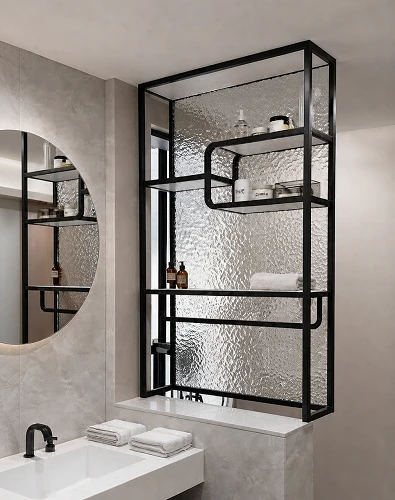
High obscuration plus high transmission makes this obscure glass a natural for wet rooms. A glue chip shower screen gives privacy without turning the enclosure into a dark box, and the surface hides water spotting better than a smooth frosted panel because the facets break up the mark.
Doors, Screens And Windows
Internal doors, pantry doors, stairwell windows and partition infills all suit it. The crystalline surface reads as a period detail in older buildings and as a deliberate texture in new ones, which is unusual for a pattern this old.
For a modern interior that wants visible structure rather than sparkle, frosted glass or a fine textured glass rib is the better fit; for a bathroom that must stay bright, the faceted surface wins.
A wider view of what this family will and will not conceal ⇒ Related Post: "Can You See Through Obscure Glass? A Privacy Guide"
Specification And Safety
Thickness And Treatment
Glue chip is produced on standard clear or low-iron float, and thickness follows the panel size and fixing rather than the pattern. Any glazing in a shower, a door or a low panel needs to break safely, so tempered or laminated glass - or a tempered-laminated build - is the normal specification.
Low-iron base glass keeps the sheet neutral. Standard clear carries a faint green edge tint that becomes obvious on thick panels and against white joinery.
What To State On The Drawing
Pattern name and code. One name, one code, used everywhere.
Pattern side. Which face carries the texture, stated per panel.
Base glass. Clear or low-iron.
Thickness and safety treatment. Driven by span and position.
Edge work. Polished, bevelled or arrissed, and whether edges stay exposed.
Buying: What To Ask A Supplier
Questions That Reveal Experience
The pattern glass suppliers worth using will ask what the panel is for before quoting, and will tell you whether the surface is glue-crazed or rolled. Ask directly: does the pattern repeat, and at what interval? A supplier who cannot answer is reselling.
Ask as well whether the pattern is a stock roller or made to order, since that decides whether a repeat order will match the first batch.
Sample Before You Commit
Photographs flatten this texture badly - a glue chip panel photographed at an angle looks like plain frosted glass. Request a physical swatch, hold it against a bright window and against a wall, and view it from the distance the finished panel will be seen at. The two readings are very different, and only the sample tells you which one your project gets.
Rain pattern glass shares the same wet-area logic and is worth comparing ⇒ Related Post: "What is rain pattern glass? Rain Pattern Shower Glass And Uses"
About Luck Glass
Luck Glass is a glass processing manufacturer focused on the deep-processing of decorative and obscure glass for both residential and commercial projects. Across our ranges we produce acid-etched, frosted, painted, fabric, textured and patterned glass, supplied as cut-to-size panels with the finish, color and safety treatment each project needs - tempered, laminated, or a combination of both. Our multiple deep-processing lines support consistent batches across large orders, and we work with distributors, contractors and brands in many countries worldwide. From a single shower screen to a multi-floor commercial fit-out, our fabrication is cut-to-size and matched to project drawings.
FAQ
Why is it called glue chip glass?
Because glue made the texture. Animal glue was spread on a warmed sheet; as it dried it contracted and tore away a thin surface layer, leaving shell-shaped fractures. The chips were the flakes it pulled off, and the name stayed with the glass even after the method changed.
Is glue chip glass the same as diamond pattern glass?
In practice, often yes. Glue chip names the process, diamond names the look - a field of angular facets that reads as diamond-cut. The same sheet is sold under both, so confirm the pattern code and compare a physical sample rather than relying on the label.
Is glue chip glass still made with glue?
Mostly not. Modern production rolls the pattern into the glass, which is cheaper and more consistent. Genuine glue-process glass still exists for restoration and feature work, and it is recognisable because the pattern never repeats.
How private is glue chip glass?
Very private. At normal viewing distance it shows no recognisable detail - no faces, no text, no shapes beyond light and colour - while transmission stays high, so the room does not go dark. Strong direct sun can throw a scattered sparkle into the space.
Can glue chip glass be tempered?
Yes. It is produced on standard clear or low-iron float and can be tempered or laminated like any patterned glass. For shower screens, doors and low-level glazing, a safety treatment is normally required by local building rules.
Summary
Glue chip glass is named for its original process: animal glue spread on a heated sheet, shrinking as it dried and tearing away a thin surface layer, leaving a field of shell-shaped fractures. The chips were the flakes the glue pulled off, and the name survived the switch to rolled production. The same surface is sold as diamond pattern glass because diamond describes how it looks rather than how it is made - one product, two naming routes, which is why pattern codes matter more than labels. What the glass does is consistent: high obscuration, high transmission, no directional grain, and a crystalline sparkle that suits shower screens, doors and windows. Specify by sample and keep one name on the paperwork.