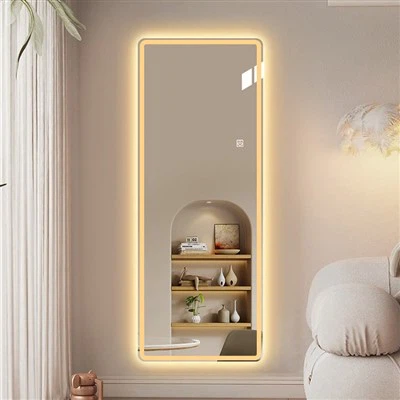
Rain pattern glass is a rolled patterned glass: clear float glass passed between rollers, one of which carries a fine diagonal engraving, so a field of narrow streaks is pressed into the surface while the sheet is still hot. The lines run at an angle rather than straight up and down, which separates it from reeded and fluted profiles and gives the glass its weather-beaten look.
What follows is how that texture behaves with light, where it belongs, and what to confirm before an order.
What The Surface Actually Is
A Rolled Pattern, Not A Coating
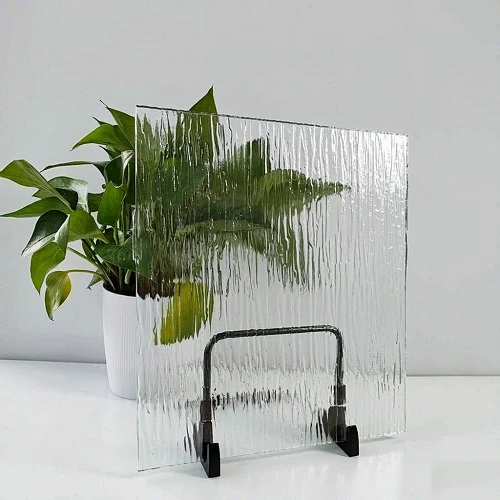
Nothing is applied to rain pattern glass - no film, no etch, no printed layer. A steel roller engraved with fine parallel lines presses into the glass as it leaves the furnace, and the sheet keeps that impression as it anneals. One face carries the streaks; the other comes out fire-polished and flat.
An etched or filmed surface can dull or lift at the edges; a rolled surface cannot delaminate from the glass because it is the glass. It can hold dirt in the grooves - a cleaning question, not a durability one.
Why It Reads As Rain
The streaks are cut close together at a shallow angle, so from a metre or two away the eye stops resolving lines and reads a soft diagonal sheen - fine lines up close, a film of moving water at standing distance. A fluted profile is the opposite, each groove wide enough to catch its own highlight.
The naming conventions across this whole family are worth knowing before you specify ⇒ Related Post: "What Do You Call Patterned Glass?"
What It Does To Light
Diffusion Rather Than Blocking
Rain pattern glass transmits most of the daylight that reaches it. It does not tint or darken; it scatters. Each streak acts as a narrow cylindrical lens, bending light off axis, so the beam arriving on the far side is spread rather than focused - the room stays bright on an overcast afternoon.
How Private It Really Is
Privacy depends on the light, not the pattern. Diffusing glass hides detail when you look from the brighter side: stand in a dim room facing a bright sky and the panel reads almost opaque; stand in a bright room looking into a dark one and silhouettes come through - a shoulder, a head, the shape of someone moving.
So it is a moderate obscuration, not a blackout. It removes recognisable detail at normal distances while keeping shapes and colours readable - the right trade for most residential bathrooms.
The light-versus-privacy trade-off is worked through in more depth here ⇒ Related Post: "Is Textured Glass See Through? Privacy & Light Explained"
Where privacy comes first, a frosted glass surface obscures more evenly, because it scatters in every direction rather than along one axis.
Rain Pattern Shower Glass
Why It Suits A Bathroom
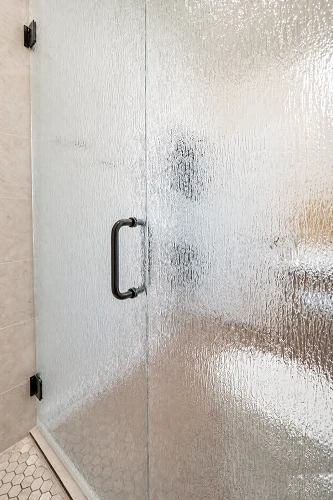
This is the application the pattern is known for. A shower needs daylight, needs screening, and gets wet several times a day. Clear glass fails the middle requirement; heavily frosted glass passes the first two but reads as a blank panel and shows every dried water spot as a pale mark.
Rain pattern sits between them: the streaks break the view into bands so the occupant is not readable, while the surface stays glossy enough to keep the room open. It also matches the way water behaves in the space.
Water, Scale And Cleaning
The grooves are the weak point. In a hard-water area mineral scale collects along them and dries into fine white lines a squeegee will not lift. The pattern does not cause the problem - any textured surface in a shower has it - but it makes it visible.
The routine is a squeegee after each use and a mild acidic descaler at intervals, worked along the line direction rather than across it. The fine, shallow streaks clean more easily than a deep ribbed profile.
Bathroom glazing rules vary by jurisdiction, and this piece sets out the common positions ⇒ Related Post: "Is It Illegal To Not Have Frosted Glass In A Bathroom?"
Direction: The Detail That Decides The Job
Matching The Streaks Across Panels
A diagonal pattern has a direction. Two panels set side by side with the streaks running opposite ways show a visible break at the joint - the texture stops, reverses and starts again. On a run of three panels beside a bath it is the first thing the eye finds.
The fix belongs in the order: state the direction on the drawing, mark the pattern side, and label each panel so the installer cannot flip one.
Which Face Points Where
The usual convention is to put the patterned face outward, toward the room and away from the wet zone, so water sits on the smooth face and the texture wipes clean. The counter-argument is that a textured face shows fingerprints less.
Either way the decision comes before tempering. In a laminated build the texture can be buried against the interlayer so both outer faces are smooth - no cleaning question, at the cost of a thicker panel.
The facing question comes up on almost every textured job ⇒ Related Post: "Does Textured Glass Face In Or Out?"
How It Compares With Its Neighbours
Same Family, Different Geometry
Rain, reeded, fluted, glue chip and minster all belong to the rolled patterned glass group, and all of them bend light rather than block it. What changes is the shape of the impression:
Rain pattern - fine diagonal streaks, shallow and glossy, moderate obscuration.
Reeded - fine parallel ribs, usually vertical, strong directional smearing.
Fluted - deeper rounded channels, bolder shadow lines, heavier look.
Glue chip - irregular crystalline texture, high obscuration, frost-like.
Minster - dense all-over figured pattern, obscures strongly, reads as traditional.
Reeded and fluted suit screens and partitions where the ribs are part of the design language. Rain pattern suits wet areas and windows, where the shallow texture cleans more easily.
Two of those profiles get confused constantly, and this piece separates them ⇒ Related Post: "What is the difference between fluted and reeded glass?"

Obscure Glass Rain Pattern In Windows And Doors
Windows And Stairwells
Small windows facing a neighbour or a street are the classic use. An obscure glass rain pattern keeps the opening bright without turning the room into a display case, and because the texture is fine it does not fight the frame. Half-landing windows gain a second benefit: the glass sits at head height, and the texture removes awkward eye contact without closing the stair off.
Internal Doors And Partitions
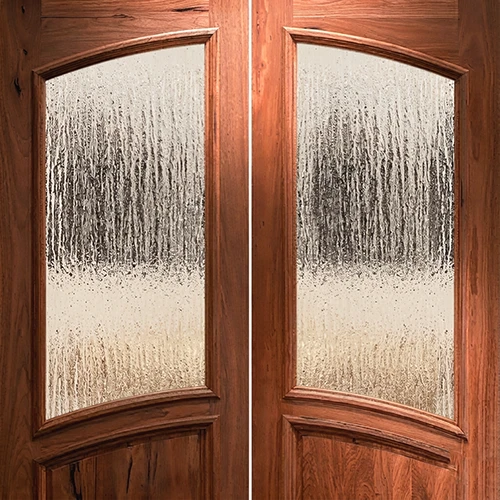
On internal doors the pattern does the same job as reeded glass - borrows light, screens the room - but with a softer, less architectural read. It suits period properties and cottage interiors where a crisp vertical rib would look too contemporary, and works on glazed pantry and utility doors where the view behind is clutter rather than composition. The wider obscure glass category covers the rest of the options.
A broader look at what obscure glass will and will not hide ⇒ Related Post: "Can You See Through Obscure Glass? A Privacy Guide"
Safety Treatment And Specification
Tempering, Laminating, Or Both
Glazing in a shower, a door or a low panel beside a floor has to break safely, which in most markets means tempered glass, laminated glass, or a tempered-laminated build. The pattern has no bearing on how the sheet fails, so safety treatment follows position and span. For enclosures, tempered is the norm; for overhead glazing or balustrades, laminated is safer.
What To Put On The Drawing
Pattern and direction. "Rain pattern, streaks running as drawn" removes ambiguity a photograph cannot.
Pattern side. Which face carries the texture, stated per panel.
Base glass. Standard clear carries a faint green edge tint; low-iron keeps the sheet neutral.
Thickness. Set by panel size, fixing method and load, not by the pattern.
Edge work. Polished, bevelled or arrissed, and whether edges are exposed or framed.
Buying: What A Supplier Should Confirm
The Questions That Sort Suppliers
A competent obscure glass supplier asks about the application before quoting: shower, window, door or partition; indoor or exposed; framed or frameless; and what the privacy requirement is. Those answers change the safety treatment, thickness and edge work.
Ask as well whether the pattern is a standard roller held in stock or cut to order, because that decides whether a repeat order will match the first batch. Pattern consistency is settled at the roller, not the cutting table.
Samples Beat Photographs
Fine diagonal textures photograph badly. A camera flattens the relief, and two different panels can look identical on screen while reading completely differently in a room. Ask for a physical swatch and hold it against a bright window as well as against a wall - the two views tell you different things about privacy.
If the project is still comparing profiles, the ribbed family guide is a useful next read ⇒ Related Post: "What Is Another Name For Ribbed Glass?"
About Luck Glass
Luck Glass is a glass processing manufacturer focused on the deep-processing of decorative and obscure glass for both residential and commercial projects. Across our ranges we produce acid-etched, frosted, painted, fabric, textured and patterned glass, supplied as cut-to-size panels with the finish, color and safety treatment each project needs - tempered, laminated, or a combination of both. Our multiple deep-processing lines support consistent batches across large orders, and we work with distributors, contractors and brands in many countries worldwide. From a single shower screen to a multi-floor commercial fit-out, our fabrication is cut-to-size and matched to project drawings.
FAQ
What is rain pattern glass?
Rain pattern glass is a rolled patterned glass with fine diagonal streaks pressed into one face during production. The streaks scatter light along one axis, so the panel stays bright while removing recognisable detail behind it. It is not coated or etched - the pattern is formed in the glass itself.
Is rain pattern glass the same as reeded glass?
No, though both are rolled patterns. Reeded glass carries parallel ribs that usually run vertically, producing strong vertical smearing. Rain pattern glass carries finer streaks set at a diagonal, which reads as a soft shimmer rather than a structural rib.
Can rain pattern glass be used in a shower?
Yes, and shower enclosures are its most common use. The panel is normally tempered, with the pattern on one face and a flat polished face on the other. In hard-water areas the grooves collect scale, so a squeegee after each use keeps the texture clear.
How private is rain pattern glass?
Moderately private. It hides detail at normal viewing distances while leaving shapes and colours readable, and the effect depends on which side is brighter. Where a silhouette must not show, a denser figured or frosted surface obscures more reliably.
Does the pattern direction matter when installing?
Yes. Diagonal streaks have a direction, and adjacent panels set with opposite directions show a visible break at the joint. State the direction on the drawing and mark each panel before tempering, since the pattern cannot be changed once the glass is cut and heat-treated.
Summary
Rain pattern glass is a rolled patterned glass whose fine diagonal streaks scatter light instead of blocking it, which is why it holds its place in shower screens, bathroom windows and internal doors. The pattern is formed by an engraved roller, not applied as a coating, so it does not peel or delaminate - though the grooves do collect scale in wet areas. Its privacy is moderate and light-dependent, hiding detail while leaving silhouettes readable in backlit conditions. What decides a finished job is specification: streak direction, which face carries the pattern, base glass, thickness, edge work and safety treatment.