Walk into any modern kitchen or bath showroom and you will see the same detail repeated: a pantry door or internal divider finished with vertical ribbed glass that blurs the view while still letting daylight through. Most of those panels are described as either reeded glass or fluted glass, and the two names get used so loosely that buyers often assume they are two different products. In practice, reeded glass and fluted glass belong to the same family of parallel-ridge textured glass - the real difference is one of profile and spacing. Reeded glass uses fine, closely packed vertical ribs; fluted glass leans toward deeper, rounded, column-like grooves. Both stay see-through, both scatter light, and both sit inside the wider world of patterned (textured) glass.
What Reeded Glass Actually Is
Reeded glass is made by passing molten glass between two rollers, at least one of which is  engraved with parallel lines. As the glass cools, those lines become raised or incised ridges running in a single direction - almost always vertical in architectural use. The result is a sheet that still transmits light but breaks up whatever sits behind it into soft vertical streaks.
The classic reeded look is subtle. The ribs are thin and crowded, so from a few feet away the glass reads as a gentle, linen-like shimmer rather than a bold pattern. That restraint is exactly why designers reach for it on reeded glass panels in places where they want privacy without a heavy, opaque wall.
A few facts worth keeping straight:
It is transparent, not frosted. You can see light and shapes through it; the ribs only distort detail.
The pattern is directional. Vertical reeding hides a person behind a door but preserves the sense of an open, lit room.
It can be toughened. Reeded glass is routinely produced as tempered (toughened) textured glass for doors and wet areas.
To see how these ridges read on a real panel and in a doorway, the visual guide is the quickest way to picture it ⇒ Related Post: "What does textured glass look like? Privacy & Door Panels"
What Fluted Glass Actually Is
Fluted glass shares the same manufacturing method - rollers press parallel lines into the hot glass - but the profile is usually pushed further. Where reeded ribs are fine and flat, fluted grooves are deeper and rounded, closer in cross-section to the vertical channels cut into a classical column. That rounding gives fluted glass a more sculptural, lens-like quality: light catches each groove and throws a softer, more pronounced play of shadow.
In day-to-day specification the two terms overlap heavily. A "fluted" shower screen and a "reeded" shower screen from two different suppliers may look almost identical. The honest distinction most glaziers use is:
Reeded = fine, closely spaced, shallow ribs.
Fluted = wider, deeper, rounded grooves with a stronger column effect.
Neither term is protected, so the only way to be sure you get the look you want is to compare a physical sample rather than trust the label.
Because both stay see-through, the practical question is how much you can actually see through them - this piece breaks that down ⇒ Related Post: "Is Textured Glass See Through? Privacy & Light Explained"
Reeded vs Fluted: The Real Overlap
The short version is that reeded and fluted glass are the same idea with a different dial setting. If you line up a fine reeded panel next to a deep fluted panel, the difference is obvious; but most catalogues sit somewhere in the middle, and many reeded glass suppliers list the two names as synonyms. Treating them as separate products is the source of most of the confusion online.
|
Trait |
Reeded glass |
Fluted glass |
|
Ridge shape |
Thin, shallow, flat-topped |
Deep, rounded, column-like |
|
Spacing |
Closely packed |
Often wider |
|
Visual weight |
Light, subtle shimmer |
Bolder, more sculptural |
|
Privacy |
Good, soft distortion |
Good, stronger distortion |
|
Light transmission |
High |
High |
|
Typical use |
Doors, screens, cabinets |
Feature doors, partitions |
Both are a subset of patterned glass, the broad category that also covers frosted, acid-etched and figured (art) glass. Reeded and fluted are simply the two names most often given to the parallel-line version.
Reeded and fluted sit inside the wider patterned-glass family, and the full map of that family is worth a look ⇒ Related Post: "What is a patterned glass?"
Where Each Works Best
Both profiles do the same jobs around the home; the choice comes down to how bold you want the texture. Three applications come up again and again.
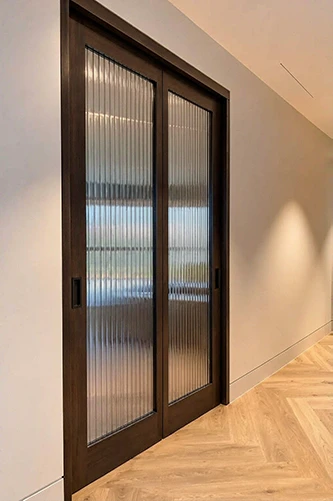
Reeded glass internal door
An reeded glass internal door is the workhorse of the trend. It lets a hallway borrow light from a bright room while screening the view of whoever is walking past. Because the ribs are fine, the door still feels light and connected to the rest of the plan - ideal between a kitchen and a dining room, or a home office and a landing. Specified as tempered reeded glass, it keeps that openness without giving up a safety rating.
For an internal door, privacy without losing daylight is the whole point - this breakdown shows how the privacy maths works ⇒ Related Post: "How Private Is Textured Glass? Light, Doors And Panels"
Reeded glass pantry door
The reeded glass pantry door is probably the single most-copied detail of the last two years. A walk-in pantry or broom cupboard sits off the kitchen, and a solid door would make the run of cabinetry feel boxed-in; a reeded door hides the clutter inside but keeps the light moving and the architecture calm. Fluted glass works here too, and reads slightly more decorative if you want the door to be a feature rather than a quiet screen.
Reeded inserts are a big part of current door design, and the trend piece explains why they keep showing up ⇒ Related Post: "What Is The New Trend For Front Doors?"
Reeded glass panels
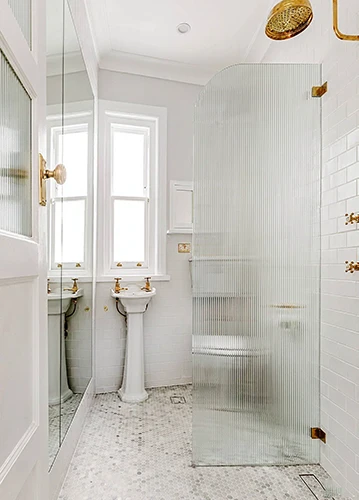
Beyond doors, reeded glass panels turn up as shower screens, cabinet fronts, wardrobe inserts and staircase balustrade infill. In each case the goal is the same: filter light, soften sightlines, and add a tactile line to an otherwise flat surface. Panels can be supplied cut-to-size and, where the location calls for it, laminated for added security.
The full decorative-glass range this belongs to - reeded, fluted, acid-etched, painted and more - is covered here ⇒ Related Post: "What are the different types of decorative glass? Types and usage"
Choosing A Profile And A Supplier
Start from the look you want, then specify backwards. If you need a quiet, light-filtering screen, fine reeded ribs are the safer pick. If you want a bolder, more architectural column effect, deeper fluted grooves will read stronger across a room. Both can be tempered, both can be laminated, and both can be cut to the panel size your project drawings call for.
When you brief reeded glass suppliers, ask for a physical sample rather than relying on the word "reeded" or "fluted" alone, since the profiles vary between mills. Confirm the glass can be supplied in the finish and safety treatment your location requires - tempered for doors and panels in most residential codes, laminated where fall-out risk or security is a concern. A good supplier will also confirm edge work (polished or bevelled) and whether the texture runs vertically or horizontally, because orientation changes how the privacy reads.
If your real goal is privacy screening rather than a decorative line, obscure glass is the next step to compare ⇒ Related Post: "Can You See Through Obscure Glass? A Privacy Guide"
About Luck Glass
Luck Glass is a glass processing manufacturer focused on the deep-processing of decorative and obscure glass for both residential and commercial projects. Across our ranges we produce acid-etched, frosted, painted, fabric and textured glass, supplied as cut-to-size panels with the finish, color and safety treatment each project needs - tempered, laminated, or a combination of both. Our multiple deep-processing lines support consistent batches across large orders, and we work with distributors, contractors and brands in many countries worldwide. From a private pantry door to a multi-floor commercial partition, our fabrication is cut-to-size and matched to project drawings.
FAQ
What is the difference between fluted and reeded glass?
Reeded glass and fluted glass describe the same family of parallel-ridge textured glass. Reeded uses fine, closely spaced, shallow ribs, while fluted leans toward deeper, rounded, column-like grooves. Many suppliers use the terms interchangeably, so the only reliable check is a physical sample.
Is reeded glass see-through?
Yes. Reeded glass stays transparent; the vertical ribs distort and blur detail but you can still see light and shapes through it. That see-through-but-private quality is what makes it useful for doors and screens.
Where is reeded glass used in the home?
Reeded glass is used for internal doors, pantry doors, shower screens, cabinet fronts, wardrobe inserts and partitions - anywhere you want daylight plus privacy without a solid wall.
How do I choose between reeded and fluted glass?
Match the look you want: fine reeded ribs give a subtle, light-filtering screen, while deeper fluted grooves give a bolder, more sculptural column effect. Both work as reeded glass panels, internal doors or pantry doors, so compare samples before deciding.
Summary
Fluted and reeded glass are two names for the same parallel-ridge textured glass; the difference is mostly in the profile. Reeded gives fine, closely spaced, shallow ribs, while fluted leans toward deeper, rounded, column-like grooves. Both stay see-through, scatter light and deliver privacy without blocking it - which is why they work so well as reeded glass internal doors, pantry doors and panels. When specifying, pick the look you want, ask suppliers for a physical sample rather than trusting the label, and confirm the tempering or lamination your project needs. Want a bolder, more architectural line? Lean fluted. A quiet, light-filtering screen? Lean reeded.
Discuss your project requirements with our team