A glass partition's thickness is set by two things: how far the pane has to span, and how it is held at the edges. A small framed screen in 4mm reeded glass can be perfectly adequate, while an unframed floor-to-ceiling partition across a wide opening needs 8–10 mm or more - and anything a person can walk into must be safety glass whatever the thickness. Thickness is a structural answer, not a product category, which is why "partition" produces different numbers on different drawings.
Why "Partition" Is Not A Thickness
The word describes a function, not a specification. A 500 mm cabinet front and a 2,400 mm room divider are both partitions, and they are not the same product.
Span, Not Area
What bends a pane is the unsupported distance between its supports, not its total square metres. A long narrow panel spanning a wide opening deflects more than a small square of the same area, because the load path is longer. That is why a quote based on area says nothing about whether the thickness is adequate - what matters is the longest unsupported edge.
Framed, Semi-Framed, Unframed
A frame does structural work. Glass held on all four edges in a rebate carries far more than the same glass held only at top and bottom. Remove the frame and the glass has to supply the stiffness itself, which is where thickness and lamination come in. Two identical partitions can need different thicknesses purely because of how they are fixed.
What Must Be Safety Glass
Glazing in a partition that people can reach - a screen beside a walkway, a door panel, a panel within reach of a floor - is normally required to be safety glass under local building regulation. That sits above thickness: a 10 mm annealed pane is no substitute for a 6 mm tempered one. Thickness answers deflection, the safety requirement answers breakage, and the two are decided separately.
Thickness and breakage behaviour are different questions, and lamination answers the second ⇒ Related Post: "What Is The Difference Between Laminated Glass And Normal Glass?"
The Thickness Ladder
Four bands cover most interior work. They are working ranges rather than rules.
4 mm: Framed Screens Only
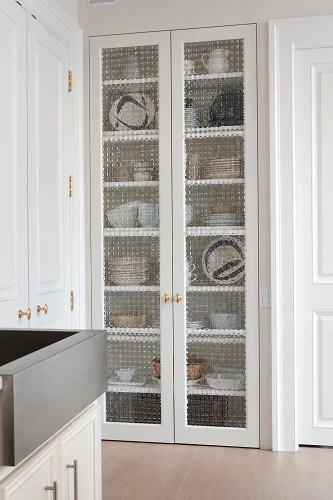
At 4 mm the glass must be continuously supported: a rebated frame, cabinet and wardrobe fronts, small screens, door lights where the frame carries the load. It does not work as a freestanding panel, and should not be used where someone might lean on it. Much of the 4mm reeded glass sold for interior work goes into exactly this kind of framed application - the ribbing is chosen for the sightline and the frame does the structural job.
6 mm: Small Screens And Door Lights
The step from 4 to 6 mm roughly doubles the stiffness, enough to allow a semi-framed screen at modest heights, held at top and bottom or on three edges. Door lights, small room dividers and domestic shower screens sit here. It is still not a panel to lean on.
8 mm: The Working Default
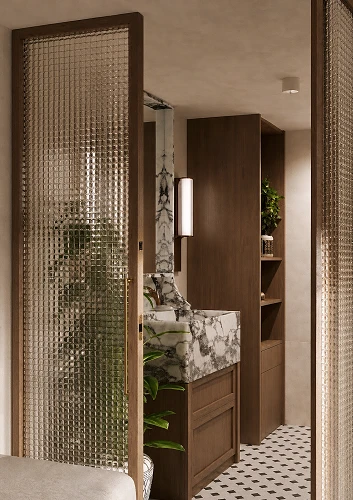
Eight millimetres is where an interior partition starts to behave like a wall rather than a window. It tolerates a semi-framed or point-fixed arrangement at normal room height, and is the usual starting point for a decorative screen that has to look unframed. Where the pattern is the reason for the partition, this is often the thickness square patterned glass is specified in: the relief stays legible without the pane becoming heavy to handle.
10 mm And Above: Long Spans, No Frame
Above 10 mm the glass is being asked to do structural work: long unsupported spans, tall panels with no intermediate rail, a screen that has to resist being pushed. The edge finish stops being cosmetic and becomes part of the design, because the edges carry the load into the fixings. Beyond this band, adding thickness is often the wrong answer - two laminated panes are stiffer and safer than one thick annealed pane. A bold geometry such as square patterned glass also holds up better here than a fine relief.
How a relief reads at a given thickness is a separate question from what the pattern is called ⇒ Related Post: "What Is Glass Texture? Types, Uses And Decorative Panels"
When Two Thin Panes Beat One Thick One
Buyers assume stiffness is bought with thickness. It is not, or not efficiently. A laminated build-up  of two thinner panes over an interlayer is stiffer than a single pane of the same total thickness, and it fails differently: if it breaks, the interlayer holds the pieces rather than letting the pane fall out.
That matters twice. A broken partition is a safety event rather than an inconvenience, because the panel is at body height. And a laminated panel can be replaced as one unit without dismantling the frame. Where the partition is tall, unframed or in a public area, lamination is usually more defensible than going thicker.
Laminated build-ups come in several configurations, and they are not interchangeable ⇒ Related Post: "What Are The Different Types Of Laminated Glass?"
Matching The Pattern To The Pane
Thickness changes how a pattern reads, and buyers rarely account for it.
A fine shallow relief loses contrast as the glass thickens, because light travels further through the pane before it is scattered. A texture that looks crisp at 4 mm can look washed out at 10 mm, and 4mm reeded glass and the same ribbing at 8 mm do not read as the same product. Directional patterns show it most clearly: the ribs are still there, but the shadow they cast is softer.
The reverse holds too. A bold geometric relief keeps its definition at greater thickness because the facets are large enough to catch light at distinct angles. Where the partition is thick and the pattern is meant to be seen, coarser geometry is safer.
Judge the pattern at the thickness it will be installed at. A pattern approved on a 4 mm sample and ordered at 8 mm is a common source of disappointment.
Whether a pattern hides anything depends on density and viewing angle, not on its name ⇒ Related Post: "Is Textured Glass See Through?"
Bathroom Partitions: Where Patterns And Thickness Collide
Bathroom screens are partitions with an extra constraint: wet, often frameless, and often specified on appearance.
That is where bathroom stained glass patterns create a real problem. Traditional stained and painted glass is often made in a craft process that does not produce tempered product, so a design that looks good in a catalogue may not be available in a safety-glass build-up at the thickness the screen needs. The pattern is not the issue; the process is. Before specifying a coloured or leaded design, confirm it can be supplied tempered or laminated, with the decorative layer inside the build-up rather than on the surface. Many bathroom stained glass patterns cannot meet that condition.
For most bathroom partitions the simpler answer is a single patterned pane in safety glass, chosen for obscuration rather than colour - one pane, one safety treatment, one fixing detail.
Bathroom glazing rules are usually driven by regulation rather than preference ⇒ Related Post: "Is It Illegal To Not Have Frosted Glass In A Bathroom?"
Where Buyers Get This Wrong
Four mistakes account for most partition problems, and all four are made before the order.
Specifying thickness by area. A large short panel is not the same problem as a narrow tall one. Give the span and the fixing method.
Assuming the frame is decorative. If it does structural work, the glass cannot later be swapped for an unframed arrangement without recalculating.
Forgetting that tempering is last. Holes and edge work happen before tempering, so a thickness decided after the drawing is issued means a new part.
Choosing the pattern at the wrong thickness. A sample in 4mm reeded glass tells you nothing about how that ribbing reads at 10 mm.
Most partition disputes trace back to a drawing, not to the glass ⇒ Related Post: "Does Textured Glass Face In Or Out?"
What To Ask Before You Order
The thickness question is usually answered by whoever cuts the part, so the supplier conversation matters more than the catalogue.
Ask three things. First, which thicknesses the pattern is actually produced in - a pattern is rolled into the glass during forming, so the available thicknesses are fixed by the pattern, not chosen freely. Second, whether they can temper or laminate at that thickness, because a supplier who can only cut leaves you sourcing the safety step elsewhere. Third, whether the sample they send is at the specified thickness rather than a stock sample at a different one.
Good pattern glass suppliers answer all three without being pushed, because those answers are the core of what they do. Weak ones quote a square-metre rate and leave the build-up to you, which is how a partition ends up with the right pattern at the wrong thickness. The question to ask directly is: at this thickness, framed this way, over this span, is this the right specification? A supplier who cannot answer that is a cutter, not a processor.
The same test separates quotes. A cheaper rate on pattern glass suppliers' price lists often reflects a narrower capability - no tempering line, no lamination, no edge work - and the missing steps reappear as cost or delay. Worth asking too whether they can advise on bathroom stained glass patterns at all, since a design that cannot be made in safety glass will fail at the last stage. That one question separates pattern glass suppliers who process from those who only stock.
The same pattern can carry three or four different names between markets, which makes like-for-like comparison harder than it looks ⇒ Related Post: "What Is Another Name For Ribbed Glass?"
About Luck Glass
Luck Glass is a glass processing manufacturer focused on the deep-processing of decorative and obscure glass for both residential and commercial projects. Across our ranges we produce acid-etched, frosted, painted, fabric and textured glass, supplied as cut-to-size panels with the finish, color and safety treatment each project needs - tempered, laminated, or a combination of both. Our multiple deep-processing lines support consistent batches across large orders, and we work with distributors, contractors and brands in many countries worldwide. From a private bathroom partition to a multi-floor commercial fit-out, our fabrication is cut-to-size and matched to project drawings.
FAQ
Is 8mm glass thick enough for a partition?
For a normal-height interior partition that is semi-framed or point-fixed, 8 mm is a common working thickness. It is not universal: a taller panel, a longer unsupported span or a fully unframed installation pushes the requirement up, and any panel people can walk into must be safety glass regardless. Give the supplier the span and the fixing detail, not the area.
Can I use 4mm glass for a room divider?
Only where the glass is continuously supported in a frame. At 4 mm the pane cannot carry itself across an opening, so it belongs in rebated frames, cabinet fronts and door lights. As a freestanding divider it deflects visibly and is not a safe specification.
Does a thicker pane make a partition safer?
Not by itself. Safety comes from breakage behaviour - tempered or laminated - not from thickness. A thick annealed pane breaks into large sharp pieces; a thinner tempered one breaks into small blunt fragments. Thickness controls deflection, which is a different problem.
Why does my pattern look different from the sample?
Almost always because the sample was a different thickness. Fine reliefs lose contrast as the glass thickens, because light travels further through the pane before scattering. Ask for the sample in the thickness you intend to order, and judge it in the lighting of the actual space.
How do I compare quotes from different pattern glass suppliers?
Compare what is included, not the square-metre rate. Ask whether cutting, edge work, drilling, tempering and lamination are covered, whether the sample is at the specified thickness, and whether the supplier can advise on span and fixing. A low rate that excludes processing is not a comparable price, and the same question separates real pattern glass suppliers from resellers.
Summary
A glass partition's thickness is decided by its unsupported span and its edge fixing, then constrained by the safety glazing requirement for its location. Framed screens work at 4 mm, small semi-framed screens at 6 mm, ordinary interior partitions at 8 mm, long unframed spans at 10 mm and above - but beyond that point a laminated build-up is stiffer and safer than a thicker pane. Two things trip buyers up: judging a pattern at the wrong thickness, since 4mm reeded glass loses contrast as the pane thickens while square patterned glass holds its definition, and choosing bathroom stained glass patterns that cannot be supplied in safety glass. Ask what pattern glass suppliers can process at the thickness the pattern is made in, and the specification stops being a guess.